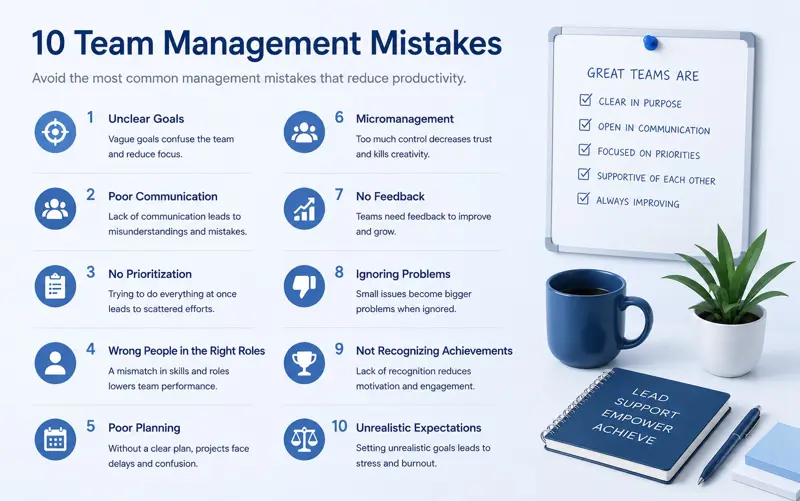
10 Team Management Mistakes: Common Errors That Reduce Productivity and Team Performance
Managing a team effectively is one of the most important responsibilities in any organization. Whether you lead a small group or a large department, your management style directly impacts productivity, communication, employee satisfaction, and overall business success.
However, even experienced managers make mistakes. Poor communication, unclear expectations, lack of planning, and micromanagement can significantly reduce team performance and create unnecessary friction.
Understanding the most common team management mistakes is the first step toward becoming a more effective leader. By recognizing these issues early, managers can improve workflows, increase motivation, and build stronger teams.
In this guide, we will explore the 10 most common team management mistakes, explain why they happen, and show how to avoid them using practical and proven methods.
Why Team Management Matters
Strong team management is essential for achieving business goals. A well-managed team works efficiently, communicates clearly, and delivers consistent results. A poorly managed team often experiences confusion, missed deadlines, and low morale.
Effective team management helps organizations:
- Improve productivity.
- Reduce misunderstandings.
- Increase employee engagement.
- Achieve project deadlines.
- Balance workloads effectively.
- Strengthen collaboration.
Good management is not about control—it is about guidance, structure, and support.
Mistake 1: Poor Communication
One of the most common and damaging team management mistakes is poor communication. When information is unclear, incomplete, or delayed, employees struggle to understand expectations and priorities.
Poor communication leads to:
- Confusion about tasks.
- Repeated mistakes.
- Missed deadlines.
- Frustration within the team.
Managers often assume that team members understand instructions, but without clear communication, assumptions quickly lead to errors.
Effective communication requires clarity, consistency, and regular updates across all levels of the team.
Mistake 2: Micromanagement
Micromanagement occurs when a manager controls every small detail of their team’s work. Instead of trusting employees to complete tasks independently, micromanagers constantly monitor, correct, and interfere with daily activities.
While this may come from a desire to ensure quality, it often has the opposite effect.
Micromanagement leads to:
- Reduced employee motivation.
- Lower creativity.
- Slower decision-making.
- Increased stress within the team.
Employees perform best when they are trusted to take ownership of their work. Managers should focus on outcomes rather than controlling every step.
Mistake 3: Lack of Clear Goals
Without clearly defined goals, teams often lose direction. Employees may stay busy, but they are not necessarily working toward meaningful outcomes.
A lack of goals leads to:
- Misaligned priorities.
- Wasted effort.
- Confusion about success criteria.
- Difficulty measuring performance.
Clear goals help teams understand what needs to be achieved and why it matters. They also make it easier to track progress and evaluate success.
Mistake 4: Poor Task Distribution
Another common mistake is uneven workload distribution. Some employees become overloaded while others have too little work.
This imbalance leads to burnout for some team members and underutilization of others.
Poor task distribution often happens when managers assign work without considering:
- Employee skills.
- Current workload.
- Project priorities.
- Available time.
A balanced workload is essential for maintaining productivity and employee satisfaction.
Mistake 5: Ignoring Employee Feedback
Employees often have valuable insights about processes, tools, and workflows. Ignoring their feedback can lead to repeated inefficiencies and missed opportunities for improvement.
When feedback is not considered, employees may feel undervalued, which can reduce engagement and motivation.
Encouraging open communication helps managers identify problems early and build a more collaborative environment.
Mistake 6: Lack of Delegation
Many managers struggle with delegating tasks effectively. Instead of trusting their team, they try to complete too many responsibilities themselves, which leads to burnout and reduced efficiency.
Poor delegation results in:
- Overloaded managers.
- Delayed project delivery.
- Underutilized team members.
- Slower decision-making.
Effective delegation means assigning tasks based on employee skills, providing clear instructions, and allowing team members to take ownership of their work.
Mistake 7: Not Providing Feedback
Feedback is essential for growth, yet many managers either provide too little feedback or only focus on problems instead of progress.
Without regular feedback, employees are unsure whether their performance meets expectations.
Lack of feedback leads to:
- Repeated mistakes.
- Low motivation.
- Unclear performance standards.
- Reduced development opportunities.
Effective feedback should be timely, specific, and balanced between positive recognition and constructive improvement.
Mistake 8: Unclear Roles and Responsibilities
When team members do not clearly understand their responsibilities, confusion and inefficiency quickly arise.
Unclear roles lead to overlapping work, missed tasks, and conflicts between employees.
Managers must ensure that every team member understands:
- What they are responsible for.
- How their work contributes to the team.
- Who they report to.
- How tasks are prioritized.
Clearly defined roles create structure and reduce unnecessary duplication of work.
Mistake 9: Poor Time Management Within the Team
Even skilled employees struggle when time is not managed properly. Without a clear structure, deadlines become unpredictable and work accumulates quickly.
Common symptoms of poor time management include:
- Missed deadlines.
- Frequent last-minute work.
- Overlapping priorities.
- Lack of focus on important tasks.
Managers should help teams prioritize work and encourage structured planning methods such as daily and weekly planning.
Mistake 10: Not Using Proper Planning Tools
Relying on spreadsheets, emails, and informal communication for complex team management often leads to confusion and inefficiency.
Without proper tools, managers struggle to:
- Track progress.
- Manage workloads.
- Coordinate tasks.
- Monitor deadlines.
Modern project management and planning tools provide visibility, structure, and real-time updates that significantly improve team coordination.
How These Mistakes Affect Team Performance
When multiple management mistakes occur simultaneously, their impact is amplified. Teams may experience reduced productivity, higher stress levels, and missed deadlines.
Over time, these issues can lead to employee dissatisfaction and increased turnover.
The key to avoiding these problems is consistent communication, structured planning, and a focus on continuous improvement.
How to Avoid Team Management Mistakes
Avoiding management mistakes requires a combination of awareness, structure, and consistent improvement. Most problems do not happen overnight—they develop gradually when communication breaks down or planning is not regularly updated.
Managers can reduce mistakes by implementing a few key practices:
- Establish clear communication channels.
- Define goals and expectations from the start.
- Use structured planning methods.
- Encourage regular feedback from employees.
- Delegate tasks based on skills and capacity.
- Track workload distribution across the team.
- Review performance and progress regularly.
When these habits are consistently applied, most common management mistakes can be significantly reduced or completely avoided.
Best Practices for Effective Team Management
Strong team management is not about controlling every detail, but about creating an environment where employees can perform at their best.
Effective managers typically focus on:
- Transparency in communication.
- Clear definition of roles.
- Balanced workload distribution.
- Regular performance reviews.
- Supportive leadership style.
- Data-driven decision-making.
These practices help teams stay aligned, motivated, and productive even during complex projects.
Tools That Help Prevent Management Mistakes
Using the right tools can significantly reduce the likelihood of management errors. Modern project and team management platforms provide visibility into tasks, deadlines, and workloads.
Useful features include:
- Task tracking and assignment.
- Team workload overview.
- Project timelines.
- Shared calendars.
- Progress reporting dashboards.
- Collaboration tools.
These tools help managers make informed decisions instead of relying on guesswork or fragmented communication.
Example: Improving a Struggling Team
Consider a team that frequently misses deadlines and experiences confusion about responsibilities. After reviewing the situation, the manager identifies several issues: unclear communication, uneven workload distribution, and lack of structured planning.
By introducing weekly planning sessions, defining clear roles, and using a project management tool to track tasks, the team begins to improve gradually. Within a few weeks, deadlines become more predictable and communication becomes clearer.
This example shows how addressing small management mistakes can significantly improve overall performance.
Frequently Asked Questions
What is the most common team management mistake?
Poor communication is the most common mistake, as it affects all other areas of team performance including task clarity, deadlines, and collaboration.
How can managers improve team performance?
Managers can improve performance by setting clear goals, improving communication, delegating tasks effectively, and using structured planning methods.
Why do management mistakes happen?
Most mistakes happen due to lack of structure, unclear expectations, or insufficient planning rather than lack of effort or intention.
Can tools help reduce management mistakes?
Yes. Project management tools help organize tasks, track progress, and improve visibility, which reduces confusion and improves coordination.
Final Thoughts
Team management mistakes are common, but they are also preventable. By understanding the most frequent errors—such as poor communication, micromanagement, unclear roles, and lack of planning—managers can take proactive steps to improve their leadership style.
The most effective teams are built on trust, structure, and continuous improvement. When managers focus on clarity, delegation, and collaboration, team performance naturally improves.
MyPlannerDesk helps teams avoid these common mistakes by providing a centralized platform for task management, workload balancing, project planning, communication, time tracking, and performance monitoring.
With better visibility and structured planning, managers can reduce errors, improve efficiency, and build stronger, more productive teams.