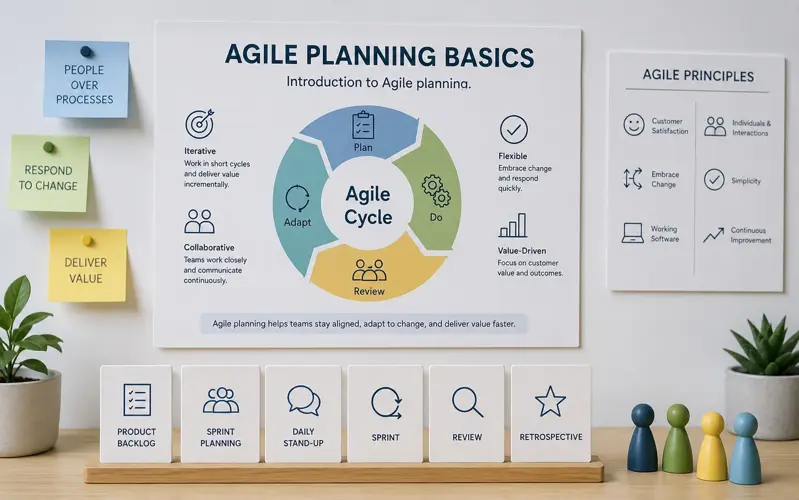
Agile Planning Basics: A Complete Introduction to Agile Planning and Iterative Work Management
Agile planning is a modern approach to project management that focuses on flexibility, collaboration, and continuous improvement. Instead of creating a rigid long-term plan at the beginning of a project, Agile teams work in short cycles called iterations or sprints, allowing them to adapt quickly to changes.
This approach is widely used in software development, product management, marketing, and any environment where requirements evolve over time. Agile planning helps teams deliver value faster, respond to feedback more effectively, and reduce the risk of building the wrong solution.
Unlike traditional planning methods that attempt to define everything upfront, Agile embraces uncertainty. It assumes that requirements will change and therefore focuses on continuous planning rather than one-time planning.
In this guide, you will learn the basics of Agile planning, how it works, common frameworks, and how teams use it to manage projects more effectively.
What Is Agile Planning?
Agile planning is a project management approach where work is divided into small, manageable increments that are planned, executed, and reviewed in repeating cycles.
Instead of planning an entire project in detail from start to finish, Agile teams plan only the next short period of work—usually one to four weeks. This allows them to adjust priorities based on feedback, new requirements, or changing business needs.
The core idea of Agile planning is:
- Plan a little.
- Execute quickly.
- Learn from results.
- Adjust continuously.
This cycle repeats throughout the entire project lifecycle.
Why Agile Planning Is Important
Many traditional projects fail because they rely on fixed plans that become outdated as soon as the project begins. Agile planning solves this problem by introducing flexibility and continuous adjustment.
Key benefits include:
- Faster delivery of results.
- Better response to changing requirements.
- Improved collaboration between teams.
- Higher customer satisfaction.
- Reduced project risk.
- More predictable progress over time.
Because work is delivered in small increments, stakeholders can see progress early and provide feedback before large amounts of time and resources are invested.
Core Principles of Agile Planning
Agile planning is based on several key principles that guide how teams organize and execute work.
1. Iterative Development
Work is divided into short cycles called iterations or sprints. Each iteration produces a usable piece of work that can be reviewed and improved.
2. Continuous Feedback
Feedback is collected regularly from stakeholders, customers, and team members. This feedback influences future planning decisions.
3. Adaptive Planning
Plans are not fixed. They evolve based on new information and changing requirements.
4. Collaboration
Agile emphasizes communication between team members, stakeholders, and customers to ensure alignment.
5. Delivering Value Early
Instead of waiting until the end of a project, Agile teams deliver usable results early and often.
How Agile Planning Works
Agile planning typically follows a repeating cycle that includes planning, execution, review, and improvement.
A simplified Agile workflow looks like this:
- Define product vision.
- Create and prioritize backlog.
- Select work for next sprint.
- Execute tasks during sprint.
- Review results with stakeholders.
- Improve and plan next iteration.
This cycle continues until the project is complete or the product reaches maturity.
Agile vs Traditional Planning
To understand Agile planning, it is helpful to compare it with traditional project planning methods.
| Aspect | Traditional Planning | Agile Planning |
|---|---|---|
| Planning style | Fixed upfront plan | Continuous planning |
| Flexibility | Low | High |
| Delivery | End of project | Incremental |
| Change handling | Difficult | Expected |
| Customer involvement | Limited | Continuous |
| Risk level | Higher | Lower |
Common Agile Frameworks
Agile planning is not a single method but a collection of frameworks that follow Agile principles.
Scrum
Scrum is the most popular Agile framework. It organizes work into fixed-length sprints, usually lasting 1–4 weeks. Each sprint has a clear goal and ends with a review and retrospective.
Kanban
Kanban focuses on continuous workflow rather than fixed iterations. Tasks move through a visual board as work progresses.
Extreme Programming (XP)
XP emphasizes technical excellence, frequent releases, and close collaboration between developers and customers.
Lean
Lean focuses on eliminating waste and maximizing value in the development process.
Agile Planning in Real Projects
In practice, Agile planning begins with a high-level vision of the product or project. This vision is broken down into smaller features or tasks that are stored in a prioritized backlog.
The team then selects a small set of tasks to complete in the next sprint. At the end of the sprint, completed work is reviewed, feedback is collected, and future planning is adjusted accordingly.
This continuous cycle ensures that the project evolves based on real-world feedback rather than assumptions made at the beginning.
Example: Agile Software Project
A software company building a new mobile application starts by defining the core features: user registration, login, and dashboard.
Instead of planning the entire application in detail, the team selects the login feature for the first sprint. After two weeks, they deliver a working version, gather feedback, and refine the next sprint based on user needs.
This process continues until the full application is complete, with each iteration improving the product.
Agile Planning Roles and Responsibilities
Agile planning relies on clearly defined roles that help teams stay organized while maintaining flexibility. Unlike traditional project management, Agile does not depend on a single decision-maker. Instead, responsibility is shared across the team.
Product Owner
The Product Owner is responsible for defining the product vision and managing the product backlog. This role prioritizes tasks based on business value and ensures that the team is always working on the most important items.
Key responsibilities include:
- Defining product requirements.
- Prioritizing backlog items.
- Communicating with stakeholders.
- Ensuring business value delivery.
Scrum Master
The Scrum Master acts as a facilitator for the team. Their job is to remove obstacles, ensure Agile practices are followed, and help the team stay focused on sprint goals.
They do not assign tasks or manage the team directly. Instead, they support the team by improving processes and encouraging collaboration.
Development Team
The development team consists of professionals who execute the actual work. They are responsible for delivering functional product increments at the end of each sprint.
In Agile, the development team is self-organizing, meaning they decide how to complete tasks without micromanagement.
Product Backlog and Sprint Planning
The product backlog is a prioritized list of all tasks, features, and requirements that need to be completed in the project. It is continuously updated as new information becomes available.
Before each sprint begins, the team holds a sprint planning session where they select items from the backlog to work on.
During sprint planning, teams define:
- What will be delivered in the sprint.
- How the work will be completed.
- What the sprint goal is.
This ensures that everyone understands the objective before work begins.
Sprints and Iterations
A sprint is a fixed period of time during which a specific amount of work is completed. Most sprints last between one and four weeks.
At the end of each sprint, the team delivers a working product increment that can be reviewed by stakeholders.
Each sprint includes:
- Sprint planning.
- Daily stand-up meetings.
- Development work.
- Testing and review.
- Sprint retrospective.
This structure ensures continuous improvement and regular delivery of value.
Daily Stand-Up Meetings
Daily stand-up meetings are short, focused sessions where team members share updates about their work.
Each team member typically answers three questions:
- What did I complete yesterday?
- What will I work on today?
- Are there any blockers?
The goal is not detailed reporting, but quick communication that helps the team stay aligned and identify problems early.
Agile Planning and Flexibility
One of the most important advantages of Agile planning is its flexibility. Unlike traditional methods that resist change, Agile assumes that change will happen and prepares for it.
Requirements may evolve based on:
- User feedback.
- Market changes.
- Technical constraints.
- Business priorities.
Because planning happens continuously, teams can adjust quickly without disrupting the entire project.
Benefits of Agile Planning
Agile planning offers several advantages compared to traditional planning methods:
- Faster delivery of value.
- Improved customer satisfaction.
- Greater adaptability to change.
- Better team communication.
- Reduced risk of project failure.
- Continuous improvement through feedback.
These benefits make Agile one of the most widely adopted planning approaches in modern organizations.
Agile Planning Example: Marketing Team
A marketing team uses Agile planning to manage content creation for a product launch campaign.
Instead of planning all content in advance, the team works in two-week iterations. In each sprint, they prioritize tasks such as blog writing, social media campaigns, and email newsletters based on performance data and feedback.
After each sprint, they analyze results and adjust future content strategies, allowing them to respond quickly to audience engagement and market trends.
Agile Planning Challenges
Although Agile planning offers many advantages, it also comes with challenges that teams must learn to manage effectively. Without discipline and proper implementation, Agile can lose its structure and become chaotic.
1. Scope Creep
Because Agile allows continuous changes, there is a risk that new features and requirements are constantly added without proper prioritization. This can lead to delays and reduced focus on core objectives.
2. Lack of Long-Term Planning
Agile focuses heavily on short-term iterations, which sometimes makes long-term planning more difficult. Teams must balance flexibility with strategic vision to avoid losing sight of overall goals.
3. Team Misalignment
If communication is weak, team members may interpret priorities differently. This can lead to inconsistent results and duplicated effort.
4. Overcommitment in Sprints
Teams sometimes take on more work than they can realistically complete in a single sprint. This reduces quality and leads to unfinished tasks being carried over.
Best Practices for Agile Planning
To get the most value from Agile planning, teams should follow proven best practices that improve consistency and performance.
- Keep sprint goals clear and realistic.
- Prioritize backlog items regularly.
- Maintain open and frequent communication.
- Review progress at the end of every sprint.
- Adapt plans based on real feedback.
- Limit work in progress to improve focus.
- Ensure stakeholders are involved in reviews.
These practices help teams maintain balance between flexibility and structure.
Agile Planning vs Traditional Planning
Understanding the difference between Agile and traditional planning helps organizations choose the right approach for their projects.
| Aspect | Traditional Planning | Agile Planning |
|---|---|---|
| Planning approach | Fixed upfront plan | Continuous adaptive planning |
| Flexibility | Low | High |
| Delivery | Single final release | Frequent incremental delivery |
| Change handling | Difficult and costly | Expected and managed |
| Customer involvement | Minimal | Continuous feedback |
| Risk level | Higher due to late discovery | Lower due to early feedback |
When to Use Agile Planning
Agile planning is most effective in environments where requirements are likely to change or are not fully known at the beginning of a project.
It is especially suitable for:
- Software development projects.
- Product design and innovation.
- Marketing campaigns.
- Startup environments.
- Research and development work.
However, Agile may be less effective in highly regulated environments or projects with fixed, unchangeable requirements such as construction or infrastructure.
Agile Planning in Practice
In real-world environments, Agile planning is rarely used in its pure form. Instead, most organizations combine Agile principles with other planning techniques such as Kanban, Gantt charts, and resource planning.
This hybrid approach allows teams to maintain flexibility while still having enough structure to manage deadlines, budgets, and dependencies.
Frequently Asked Questions
Is Agile only for software development?
No. While Agile originated in software development, it is now widely used in marketing, product management, HR, and many other industries.
How long is a typical sprint?
Most Agile teams use sprints that last between one and four weeks depending on project complexity and team structure.
What is the main goal of Agile planning?
The main goal is to deliver value quickly while remaining flexible and responsive to change.
Do Agile teams plan everything in advance?
No. Agile teams plan only the near future in detail and continuously adjust plans based on feedback and priorities.
Final Thoughts
Agile planning represents a shift from rigid, long-term scheduling to flexible, continuous planning that adapts to real-world conditions. By breaking work into small increments, encouraging collaboration, and embracing change, Agile helps teams deliver better results with lower risk.
When combined with complementary methods like Kanban, time blocking, and resource planning, Agile becomes an even more powerful framework for managing modern projects.
MyPlannerDesk supports Agile planning by providing tools for backlog management, Kanban boards, sprint tracking, task assignment, workload balancing, time tracking, and real-time collaboration. Teams can plan and execute Agile workflows in one centralized platform while maintaining full visibility over progress and priorities.
By applying Agile principles consistently, organizations can improve productivity, respond faster to change, and continuously deliver value to their customers.