Capacity Planning: Complete Guide to Resource Capacity and Workload Management
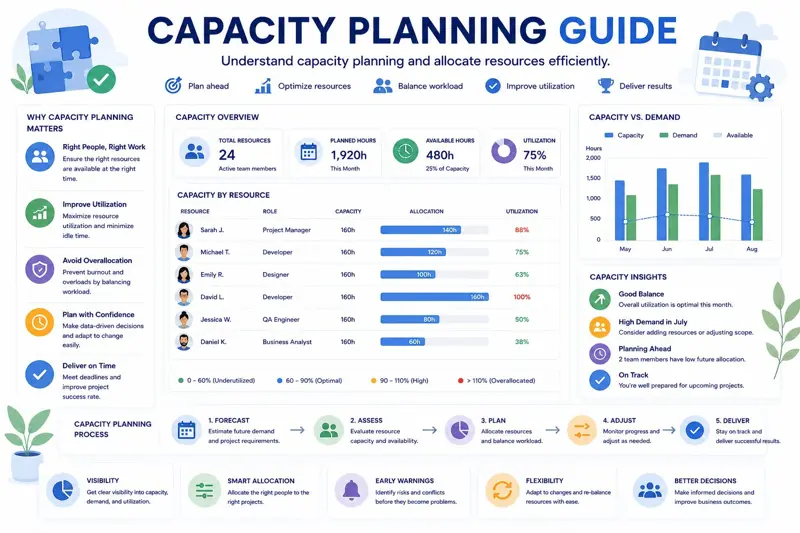
Capacity planning is a critical process in project management and business operations that ensures an organization has the right amount of resources to meet current and future demand. It helps teams balance workloads, avoid overload, and deliver projects on time without wasting available capacity.
Without proper capacity planning, teams often face common problems such as missed deadlines, employee burnout, uneven workload distribution, and inefficient use of resources. On the other hand, well-structured capacity planning improves productivity, stability, and long-term predictability.
In simple terms, capacity planning answers one key question:
Do we have enough people, time, and resources to complete all planned work?
This guide explains how capacity planning works, why it is important, and how organizations can use it to improve project delivery and team performance.
What Is Capacity Planning?
Capacity planning is the process of determining the maximum amount of work that a team or organization can complete within a specific period based on available resources.
It involves analyzing employee availability, skills, workload distribution, project demands, and deadlines to ensure that work is assigned realistically.
Capacity planning helps managers understand whether:
- The team is overloaded.
- There is unused capacity.
- More resources are needed.
- Deadlines are realistic.
The goal is to match demand (work to be done) with supply (available resources) as accurately as possible.
Why Capacity Planning Is Important
Many organizations struggle not because they lack talent, but because they mismanage workload distribution. Without capacity planning, it becomes easy to overcommit teams or underestimate the effort required for projects.
Proper capacity planning helps organizations:
- Avoid employee burnout.
- Improve workload balance.
- Increase project predictability.
- Reduce missed deadlines.
- Optimize resource usage.
- Improve long-term planning accuracy.
It also provides managers with a clear overview of who is working on what and how much capacity remains available for new tasks or projects.
Key Elements of Capacity Planning
Effective capacity planning is built on several important components that work together to provide a complete picture of available resources.
1. Resource Availability
This refers to the total time employees have available for work after accounting for holidays, meetings, and non-project activities.
2. Workload Demand
Workload demand represents all tasks, projects, and activities that need to be completed within a given timeframe.
3. Skill Matching
Not all employees can perform all tasks. Capacity planning must consider skill sets to ensure work is assigned appropriately.
4. Time Estimation
Accurate estimation of task duration is essential for predicting whether capacity is sufficient.
5. Resource Constraints
These include limitations such as budget, equipment, and external dependencies that can impact capacity.
Types of Capacity Planning
Capacity planning can be divided into different types depending on time horizon and purpose.
1. Short-Term Capacity Planning
Focuses on immediate workload distribution, typically covering days or weeks. It is used for task assignment and daily operational management.
2. Medium-Term Capacity Planning
Covers weeks or months and is commonly used for project scheduling and team coordination.
3. Long-Term Capacity Planning
Focuses on strategic planning, resource hiring, budgeting, and organizational growth over several months or years.
Capacity Planning vs Resource Planning
Although the terms are often used interchangeably, capacity planning and resource planning are not the same.
| Aspect | Capacity Planning | Resource Planning |
|---|---|---|
| Focus | How much work can be done | How resources are assigned |
| Purpose | Balance workload vs availability | Assign specific tasks |
| Time frame | Medium to long-term | Short to medium-term |
| Outcome | Workload capacity overview | Task allocation plan |
Capacity planning determines whether enough resources exist, while resource planning determines how those resources are used.
How Capacity Planning Works
The capacity planning process typically follows several structured steps:
- Identify available resources.
- Calculate total working capacity.
- List all planned work.
- Estimate workload requirements.
- Compare demand vs capacity.
- Adjust assignments if needed.
This process helps ensure that workload distribution is realistic and aligned with actual team capabilities.
Example: Team Capacity Planning
Imagine a team of five employees, each available for 35 productive hours per week. This gives a total team capacity of 175 hours per week.
If planned work for the week requires 220 hours, the team is over capacity by 45 hours. In this situation, the manager must either:
- Reduce workload.
- Extend deadlines.
- Add additional resources.
- Reprioritize tasks.
Without capacity planning, this overload would only become visible after delays and missed deadlines occur.
Capacity Planning in Project Management
In project management, capacity planning plays a crucial role in ensuring that projects are delivered on time and within budget. It helps project managers understand whether their teams can realistically handle the assigned workload.
Without capacity planning, project schedules are often based on assumptions rather than actual resource availability, which leads to delays and inefficiencies.
Project managers use capacity planning to:
- Balance workload across team members.
- Forecast project completion dates.
- Allocate resources efficiently.
- Identify potential bottlenecks early.
- Adjust timelines based on real capacity.
This makes capacity planning an essential part of any structured project management approach.
Capacity Planning for Teams
At the team level, capacity planning focuses on distributing work fairly and ensuring that no team member is overloaded while others remain underutilized.
Managers typically review:
- Individual availability.
- Skill levels.
- Current task assignments.
- Upcoming deadlines.
- Time off and absences.
By analyzing these factors, managers can assign tasks more effectively and maintain a balanced workload across the team.
Common Capacity Planning Challenges
Although capacity planning is highly effective, it is not without challenges. Many organizations struggle with accurate forecasting and data consistency.
Some common challenges include:
- Inaccurate time estimates for tasks.
- Unplanned urgent work disrupting schedules.
- Frequent changes in project priorities.
- Limited visibility into team workloads.
- Overlapping responsibilities across departments.
These challenges can reduce the accuracy of capacity planning if not properly managed.
Best Practices for Capacity Planning
To improve the effectiveness of capacity planning, organizations should follow several best practices that ensure more accurate and reliable results.
- Track actual time spent on tasks regularly.
- Update capacity plans weekly or biweekly.
- Include buffer time for unexpected work.
- Use historical data for better forecasting.
- Involve team members in estimation.
- Align capacity planning with project priorities.
These practices help managers create more realistic plans and reduce the risk of overloading teams.
Capacity Planning Tools
Modern organizations use digital tools to simplify capacity planning and improve visibility across teams and projects.
These tools typically provide features such as:
- Workload dashboards.
- Resource allocation tracking.
- Time tracking and reporting.
- Project scheduling views.
- Team availability calendars.
By centralizing this information, managers can make faster and more informed decisions about workload distribution.
Example: Overloaded Development Team
A software development team is assigned multiple projects with overlapping deadlines. Without capacity planning, the manager assumes that all tasks can be completed within the given timeline.
However, after analyzing actual capacity, it becomes clear that the team is overbooked by 30%. Some tasks are rescheduled, priorities are adjusted, and additional resources are added to balance the workload.
As a result, the team avoids burnout and project delivery becomes more predictable.
Advanced Capacity Planning Strategies
Advanced capacity planning goes beyond simple workload balancing. It focuses on predicting future demand, optimizing resource utilization, and ensuring that organizations are prepared for growth or sudden changes in workload.
One of the key strategies is forecasting, where historical data is used to predict future resource needs. This helps managers anticipate periods of high demand and adjust staffing or scheduling in advance.
Another important strategy is scenario planning, where different workload situations are simulated. For example, managers may prepare for best-case, expected, and worst-case workload scenarios to ensure flexibility.
Capacity Planning and Forecasting
Forecasting is closely linked to capacity planning. It helps organizations estimate future demand based on past performance, seasonal trends, and business growth expectations.
Accurate forecasting allows managers to:
- Prepare for peak workloads.
- Reduce resource shortages.
- Improve hiring decisions.
- Plan budgets more effectively.
When forecasting is combined with capacity planning, organizations gain a much clearer view of their long-term resource needs.
Capacity Planning for Scaling Teams
As organizations grow, capacity planning becomes even more important. Scaling teams often face challenges such as increased workload complexity, more projects running in parallel, and higher coordination requirements.
Effective scaling requires:
- Regular capacity reviews.
- Clear workload visibility across teams.
- Standardized planning processes.
- Efficient task prioritization.
- Strategic hiring decisions based on demand.
Without proper capacity planning, growing teams often experience bottlenecks that slow down overall productivity.
Common Mistakes in Capacity Planning
Even experienced managers make mistakes when planning capacity. These errors can lead to unrealistic schedules and overloaded teams.
Some of the most common mistakes include:
- Ignoring non-productive time such as meetings and admin tasks.
- Overestimating employee availability.
- Failing to update capacity plans regularly.
- Not accounting for unexpected urgent work.
- Relying on outdated data.
Avoiding these mistakes is essential for maintaining accurate and reliable capacity planning.
Frequently Asked Questions
What is the main purpose of capacity planning?
The main purpose is to ensure that an organization has enough resources to complete all planned work without overloading employees or missing deadlines.
How often should capacity planning be done?
Most organizations update capacity plans weekly or monthly depending on the pace of their projects and workload changes.
Is capacity planning only for large companies?
No. Even small teams benefit from capacity planning because it helps balance workloads and improve efficiency regardless of company size.
What tools are used for capacity planning?
Teams often use project management tools, spreadsheets, time tracking software, and dedicated capacity planning platforms.
Final Thoughts
Capacity planning is a fundamental part of effective project and team management. It ensures that workloads are balanced, deadlines are realistic, and resources are used efficiently.
Organizations that invest in proper capacity planning are better prepared for growth, change, and unexpected challenges. They also experience fewer delays, lower employee burnout, and more predictable project outcomes.
MyPlannerDesk simplifies capacity planning by providing real-time visibility into team workloads, project timelines, resource availability, and task distribution. With centralized data and clear reporting, managers can make faster and more accurate planning decisions.
By combining capacity planning with modern project management practices, organizations can significantly improve productivity, efficiency, and long-term success.