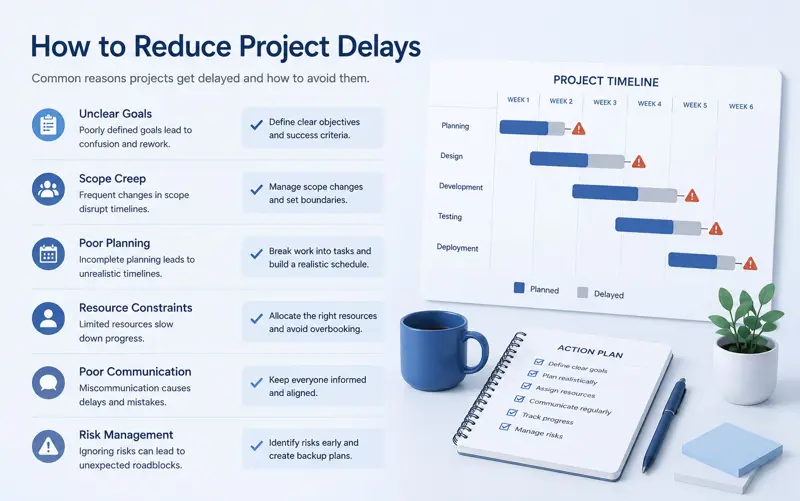
How to Reduce Project Delays: Practical Strategies That Keep Projects on Schedule
Project delays are one of the biggest challenges organizations face, regardless of industry or company size. Whether you are managing software development, construction projects, marketing campaigns, or internal business initiatives, missing deadlines usually leads to increased costs, frustrated clients, lower team morale, and lost business opportunities.
The good news is that most project delays are preventable. They rarely happen because employees are unwilling to work. More often, delays are caused by poor planning, unclear priorities, lack of communication, unrealistic expectations, or the absence of proper project management tools.
This guide explains the most common causes of project delays and provides practical techniques that project managers and team leaders can use to keep projects moving forward. Whether your company manages five projects or five hundred, these strategies will help improve planning, communication, and overall project delivery.
Why Projects Get Delayed
Many organizations believe delays occur because employees work too slowly. However, research and real-world experience show that delays are usually the result of management and planning issues rather than individual performance.
Before solving the problem, it's important to understand its root causes.
| Common Cause | Impact |
|---|---|
| Unclear project scope | Team members work toward different goals. |
| Poor communication | Important information is lost or delayed. |
| Unrealistic deadlines | Employees rush work and quality decreases. |
| Resource shortages | Tasks cannot start on time. |
| Changing priorities | Teams constantly switch focus. |
| No progress tracking | Problems are discovered too late. |
Understanding which of these factors affects your organization is the first step toward improving project performance.
Start Every Project with Clear Objectives
One of the most common reasons projects fall behind schedule is that team members never fully understand what success looks like.
A project should begin with clearly defined objectives, expected deliverables, deadlines, responsibilities, and measurable outcomes.
For example, imagine a software development team receives the following task:
"Build a customer portal."
Although this sounds straightforward, it leaves many unanswered questions. Should the portal support mobile devices? Will customers upload documents? Should managers receive notifications? Which departments are involved? Without clear answers, every employee will interpret the project differently.
Instead, define objectives in measurable terms:
- Create a responsive customer portal.
- Allow secure document uploads.
- Enable online invoice viewing.
- Provide email notifications.
- Complete implementation by September 30.
The clearer the objective, the fewer misunderstandings your team will face.
Break Large Projects into Smaller Tasks
Large projects often appear overwhelming because they consist of dozens—or even hundreds—of individual activities.
Instead of treating a project as one enormous task, divide it into manageable pieces that can be assigned to specific team members.
For example, instead of creating one task called:
"Launch New Website"
Create smaller tasks such as:
- Prepare project requirements.
- Create wireframes.
- Design homepage.
- Develop user authentication.
- Create blog section.
- Test mobile responsiveness.
- Perform security review.
- Deploy to production.
Smaller tasks are easier to estimate, monitor, and complete. They also help project managers identify delays before they become critical.
Assign Clear Ownership
Nothing slows a project more than uncertainty about responsibility.
Every task should have one clearly identified owner. Even if several people are working together, one person should remain accountable for tracking progress and ensuring completion.
For example:
| Task | Owner | Status |
|---|---|---|
| Homepage Design | Sarah | In Progress |
| Database Migration | Michael | Planned |
| Customer Testing | Emma | Not Started |
Clear ownership eliminates confusion and increases accountability throughout the project.
Monitor Progress Every Day
One of the biggest mistakes project managers make is waiting until weekly meetings to discover problems.
A small issue that remains unnoticed for five days can quickly become a major delay affecting the entire project schedule.
Successful teams monitor progress continuously rather than occasionally. Daily updates allow managers to identify blocked tasks, overloaded employees, and resource shortages before deadlines are affected.
Modern planning software makes this process much easier by displaying project status in real time. Managers can instantly see completed work, overdue tasks, and upcoming deadlines from a single dashboard instead of manually updating multiple spreadsheets.
If your team still relies on spreadsheets, consider reading our article Planner vs Excel – Which Is Better for Project Management?, where we compare traditional Excel-based planning with dedicated planning software.
Choose the Right Planning Method
Not every project should be managed in the same way. Some projects benefit from visual task boards, while others require detailed timelines and dependency tracking.
For example, a marketing team managing social media campaigns may work more efficiently with a Kanban board, while a construction project involving dozens of dependent activities will benefit from a Gantt chart.
If you're unsure which planning method fits your organization, read our comparison: Kanban vs Gantt – When Should You Use Each?. Choosing the right planning approach from the beginning can significantly reduce project delays later.
Identify Risks Before They Become Problems
Experienced project managers know that every project carries risks. The difference between successful and unsuccessful projects is not the absence of risks but how early they are identified and managed.
Risk management should begin during project planning rather than after work has already started. Waiting until a problem appears often means the project is already behind schedule.
Start every project by asking questions such as:
- Which activities are most likely to be delayed?
- Which team members are critical to project success?
- Are external suppliers involved?
- Could vacations or holidays affect the schedule?
- Are there legal or regulatory approvals required?
- What happens if one task finishes late?
Documenting these risks allows your team to prepare contingency plans instead of reacting under pressure.
Example
Imagine a software company planning to launch a new customer portal. During planning, the project manager discovers that the integration with a third-party payment provider could take several weeks longer than expected because approval depends on an external organization.
Instead of waiting until the deadline approaches, the manager schedules this integration first, allowing enough time for unexpected delays while the rest of the development continues in parallel.
This simple decision may save weeks of project delay.
Plan Resources Realistically
Many projects fail because managers assume employees are available 100% of the time. In reality, people attend meetings, answer emails, support customers, take vacations, participate in training, and sometimes become unavailable due to illness.
When estimating project duration, always include realistic resource availability.
For example, assigning 40 hours of project work to someone who spends half of their week supporting customers almost guarantees missed deadlines.
| Employee | Weekly Capacity | Project Allocation | Available Hours |
|---|---|---|---|
| Project Manager | 40 | 50% | 20 |
| Developer | 40 | 80% | 32 |
| Designer | 40 | 60% | 24 |
| QA Engineer | 40 | 70% | 28 |
Planning based on actual availability creates more realistic schedules and reduces last-minute surprises.
Avoid Scope Creep
One of the most dangerous causes of project delays is scope creep.
Scope creep occurs when additional features, requirements, or changes are added after work has already begun without adjusting deadlines or resources.
Consider a website redesign project originally planned to include ten pages. Halfway through development, the client requests:
- A blog.
- Customer login.
- Online payments.
- Multi-language support.
- Live chat.
Each request may seem reasonable on its own, but together they dramatically increase the amount of work required.
Professional project managers evaluate every requested change by considering:
- Additional development time.
- Testing effort.
- Documentation updates.
- Impact on deadlines.
- Additional project costs.
If the scope changes, the project schedule should change as well.
Improve Team Communication
Communication problems are responsible for many project delays. Important information often remains inside email threads, private chat messages, or individual conversations.
Instead, every project should have one central place where employees can view:
- Current tasks.
- Deadlines.
- Responsibilities.
- Project documents.
- Status updates.
- Open issues.
When everyone works from the same information, misunderstandings become far less common.
Hold Short Daily Meetings
Many successful teams use short daily stand-up meetings lasting no more than 15 minutes.
Each team member answers three simple questions:
- What did I complete yesterday?
- What will I work on today?
- Is anything blocking my progress?
These brief meetings help managers detect problems early while keeping the team aligned.
Track Dependencies Carefully
Projects often contain tasks that depend on one another.
For example, software testing cannot begin until development is complete, and user training cannot start until the application is stable.
When one critical task slips by only two days, every dependent activity may also move by two days or more.
This domino effect explains why even small delays can eventually postpone an entire project.
Using planning software makes dependency management much easier because project managers can immediately see which activities will be affected by schedule changes.
Learn from Completed Projects
Every finished project provides valuable lessons for future planning.
After project completion, schedule a short review meeting with the entire team. Discuss:
- What went well?
- Which activities took longer than expected?
- Which estimates were inaccurate?
- Which communication problems occurred?
- What should be improved next time?
Document these lessons and use them when planning future projects. Over time, your estimates become more accurate, your schedules become more realistic, and your teams become significantly more productive.
Case Study: Reducing Delays by 40%
A small marketing agency managed all client projects using Excel spreadsheets and email. Every employee maintained their own task list, resulting in missed deadlines, duplicate work, and constant status meetings.
The company decided to centralize project planning using a dedicated planning system. Every task received an owner, deadlines became visible to the entire team, and project managers reviewed progress every morning.
Within three months, overdue tasks dropped significantly, internal meetings became shorter, and projects were delivered approximately 40% faster than before.
The biggest improvement was not employee productivity—it was better visibility into project progress.
10 Warning Signs Your Project Is Falling Behind
Projects rarely fail overnight. In most cases, there are warning signs weeks before deadlines are missed. Successful project managers recognize these signs early and take corrective action before small problems grow into major delays.
- Tasks remain "In Progress" for too long.
- Employees regularly miss internal deadlines.
- Project meetings focus on problems instead of solutions.
- Priorities change several times each week.
- Team members frequently wait for approvals.
- Resource conflicts become common.
- Clients request frequent changes.
- Managers spend more time asking for status updates than reviewing results.
- Quality issues increase.
- Overtime becomes the normal way of working.
If several of these warning signs appear simultaneously, the project needs immediate attention.
Create a Weekly Project Review Routine
One of the easiest ways to reduce project delays is establishing a consistent weekly review process.
Every Friday afternoon or Monday morning, review every active project using the same checklist.
Weekly Project Manager Checklist
- Review completed tasks.
- Identify overdue activities.
- Confirm next week's priorities.
- Check employee workloads.
- Update project timelines.
- Review project risks.
- Confirm client approvals.
- Resolve blocked tasks.
- Adjust resource allocation if necessary.
- Communicate updates to the team.
This simple routine usually takes less than one hour but can prevent days or even weeks of unnecessary delays.
Use Project Dashboards Instead of Spreadsheets
Many organizations still rely on Excel spreadsheets to monitor project status. While spreadsheets work well for calculations, they are not designed for real-time collaboration.
Modern project dashboards provide an instant overview of:
- Project progress.
- Upcoming deadlines.
- Overdue tasks.
- Employee workload.
- Project completion percentage.
- Open issues.
Instead of searching through multiple files and email conversations, managers can immediately identify projects requiring attention.
If your organization still manages projects in spreadsheets, read our article Planner vs Excel – Which Is Better for Project Management? to understand when it is time to switch to dedicated planning software.
Encourage Accountability Without Micromanagement
One common mistake is believing that reducing project delays requires constant supervision. In reality, excessive micromanagement often slows projects even further.
Instead of checking every detail throughout the day, establish clear expectations, assign ownership, and review measurable progress regularly.
Employees perform best when they understand:
- What is expected.
- Why the work is important.
- When it must be completed.
- Who depends on their work.
Accountability creates responsibility without reducing employee autonomy.
Build a Culture of Continuous Improvement
Reducing project delays is not a one-time activity. Every completed project provides valuable information that can improve future planning.
Encourage teams to discuss lessons learned openly instead of assigning blame. Questions such as these create continuous improvement:
- Which estimates proved inaccurate?
- Which communication methods worked best?
- Which recurring problems should be eliminated?
- How can planning become more accurate next time?
Organizations that continuously improve their planning processes consistently deliver projects faster than competitors.
Recommended Reading
If you found this article helpful, you may also enjoy:
- Planner vs Excel – Which Is Better for Project Management?
- Kanban vs Gantt – When Should You Use Each?
- How to Organize Employees' Workday
- How to Track Project Progress Effectively
- Time Blocking Explained
Frequently Asked Questions
What is the most common cause of project delays?
Poor planning, unclear priorities, ineffective communication, and unrealistic deadlines are among the most common reasons projects fall behind schedule.
How often should project progress be reviewed?
Daily monitoring combined with a structured weekly review provides the best balance between visibility and productivity.
Can project management software reduce delays?
Yes. Modern planning software improves visibility, centralizes communication, tracks deadlines, and helps managers identify problems before they affect the project schedule.
Should every project use a Gantt chart?
Not necessarily. Gantt charts work best for projects with timelines and task dependencies, while Kanban boards are often better for continuous workflows.
How can small businesses improve project delivery?
Small businesses should focus on defining clear goals, assigning task owners, tracking progress regularly, and using centralized planning tools instead of multiple spreadsheets.
What is scope creep?
Scope creep occurs when new requirements are added after a project has started without adjusting the schedule, budget, or available resources.
Why is accountability important?
When every task has a clearly identified owner, responsibilities become clear, communication improves, and delays are easier to prevent.
Final Thoughts
Project delays are rarely caused by a single event. They usually result from a combination of poor planning, unclear communication, unrealistic expectations, and the absence of reliable project tracking.
The most successful organizations focus on prevention rather than reaction. They define clear objectives, divide projects into manageable tasks, monitor progress continuously, identify risks early, and learn from every completed project.
Whether your team manages internal initiatives, client projects, or large-scale business operations, adopting these practices will significantly improve your ability to deliver projects on time.
Using a centralized planning solution such as MyPlannerDesk helps teams organize projects, assign responsibilities, monitor deadlines, and gain complete visibility into project progress. By replacing scattered spreadsheets and disconnected communication with one collaborative workspace, organizations can reduce delays, improve productivity, and deliver better results for both employees and clients.