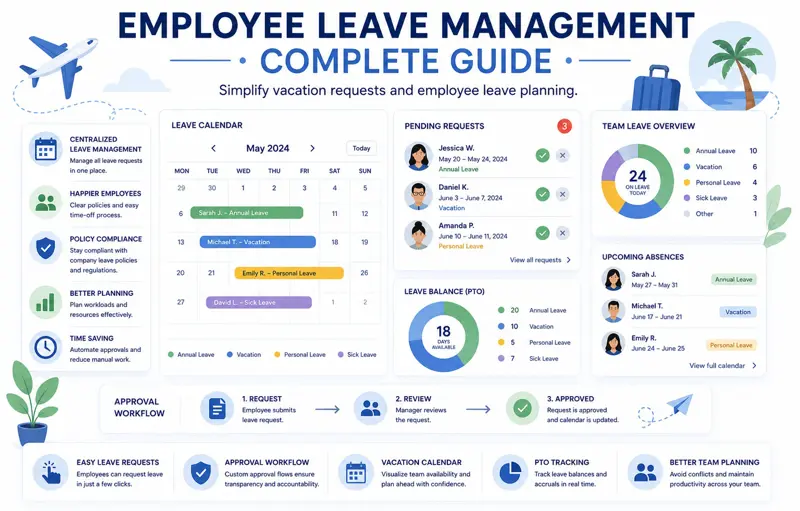
Employee Leave Management: The Complete Guide to Vacation and Time-Off Planning
Managing employee leave is one of the most important responsibilities for HR departments, managers, and business owners. Whether employees request annual leave, sick leave, parental leave, or unpaid time off, every absence affects team productivity, project schedules, and overall business operations.
Many organizations still manage leave requests using spreadsheets, paper forms, or long email conversations. While these methods may work for very small teams, they quickly become inefficient as the company grows.
Managers often struggle to answer simple questions such as:
- Who is on vacation next week?
- How many vacation days does an employee have remaining?
- Can two employees from the same department take leave simultaneously?
- Will approved leave delay an important project?
- Who will replace an employee during their absence?
Without a structured leave management process, organizations experience staffing shortages, scheduling conflicts, payroll errors, and frustrated employees.
An effective employee leave management system provides complete visibility into employee availability while ensuring that business operations continue running smoothly throughout the year.
What Is Employee Leave Management?
Employee leave management is the process of requesting, approving, tracking, and reporting employee absences. It ensures that employees receive their entitled leave while allowing managers to maintain sufficient staffing levels and avoid operational disruptions.
Modern leave management includes much more than simply recording vacation days. It also involves planning resources, monitoring employee availability, coordinating project schedules, and maintaining compliance with company policies.
A complete leave management process typically includes:
- Submitting leave requests.
- Manager approval workflows.
- Vacation balance tracking.
- Public holiday calendars.
- Department availability planning.
- Conflict detection.
- Leave reporting and analytics.
When these activities are managed in one centralized system, managers gain a clear overview of workforce availability while employees enjoy a simpler and more transparent approval process.
Why Leave Management Is Important
Employee absences are inevitable, but poor planning should not be.
Without proper leave management, businesses often encounter problems such as:
- Too many employees taking leave at the same time.
- Projects delayed because key specialists are unavailable.
- Payroll inaccuracies.
- Confusion about remaining vacation balances.
- Managers spending excessive time approving requests manually.
- Employee dissatisfaction caused by inconsistent approval decisions.
A structured leave management process benefits both employees and employers by creating fairness, improving transparency, and supporting better workforce planning.
Different Types of Employee Leave
Although regulations vary between countries, most organizations manage several common types of leave.
| Leave Type | Purpose |
|---|---|
| Annual Leave | Planned vacation and personal time off. |
| Sick Leave | Employee illness or medical recovery. |
| Parental Leave | Birth or adoption of a child. |
| Unpaid Leave | Approved personal leave without salary. |
| Bereavement Leave | Family emergency following a death. |
| Study Leave | Professional education and certification. |
| Public Holidays | National or company-recognized holidays. |
Clearly defining leave categories helps employees understand company policies and simplifies reporting.
Create a Transparent Leave Policy
Every organization should have a written leave policy that explains how leave requests are handled.
A comprehensive policy should answer questions such as:
- How many annual leave days are employees entitled to?
- How far in advance should vacation be requested?
- Who approves leave requests?
- Can unused leave be carried into the following year?
- How are emergency absences handled?
- Can leave requests be cancelled or modified?
Clear policies reduce misunderstandings while ensuring consistent decisions across the organization.
Plan Vacations Early
One of the easiest ways to avoid staffing shortages is encouraging employees to submit vacation requests well in advance.
Annual vacation planning provides managers with sufficient time to coordinate resources, adjust project schedules, and approve requests fairly.
Early planning also benefits employees because they are more likely to receive their preferred vacation dates.
Monitor Team Availability
Approving leave requests without checking overall team availability can create serious operational problems.
Before approving leave, managers should review:
- Current project deadlines.
- Department staffing levels.
- Existing approved leave.
- Employee workloads.
- Critical business activities.
- Customer commitments.
A shared leave calendar provides immediate visibility into employee availability, making approval decisions much easier.
Avoid Vacation Conflicts
Vacation conflicts occur when multiple employees from the same department request leave during the same period.
Instead of making inconsistent decisions, organizations should establish clear approval rules before conflicts occur.
Examples include:
- First request submitted receives priority.
- Critical business periods limit vacation approvals.
- Managers ensure minimum staffing levels.
- Vacation schedules rotate fairly between employees.
- Key specialists should not all be absent simultaneously.
Fair and transparent conflict resolution improves employee trust while maintaining business continuity.
Example Leave Calendar
| Employee | Department | Status | Dates |
|---|---|---|---|
| Emma | Marketing | Approved | July 10 – July 21 |
| Michael | IT | Pending | July 15 – July 19 |
| Sarah | Sales | Approved | August 1 – August 12 |
| David | Finance | Approved | August 8 – August 15 |
A centralized leave calendar allows managers to identify conflicts immediately instead of discovering staffing problems after vacations have already been approved.
If you're interested in improving workforce planning, continue with our guide Employee Scheduling: The Complete Guide .
You may also find Employee Workload Management helpful for balancing employee availability with project demands.
Create a Simple Leave Approval Workflow
A well-defined approval process ensures that every leave request is handled consistently and fairly. Employees should always know how to submit requests, who approves them, and how long the approval process typically takes.
A typical leave approval workflow follows these steps:
- Employee submits a leave request.
- The system checks for scheduling conflicts.
- The manager reviews staffing availability.
- The request is approved or rejected.
- The employee receives a notification.
- The shared leave calendar is automatically updated.
Automating these steps significantly reduces administrative work while ensuring that managers always have the latest information available.
Track Leave Balances Automatically
One of the most common administrative challenges is calculating the remaining leave balance for each employee.
Manual calculations often lead to mistakes, especially when employees receive additional leave days based on seniority or carry unused vacation into the next year.
A leave management system should automatically calculate:
- Total annual entitlement.
- Approved leave.
- Pending requests.
- Remaining available days.
- Carried-over leave.
- Expired leave.
Real-time leave balances improve transparency while reducing HR workload.
Support Half-Day and Hourly Leave
Not every absence requires a full day off. Employees may need only a few hours for a medical appointment, school meeting, or personal obligation.
Modern leave management systems should support:
- Full-day leave.
- Half-day leave.
- Hourly leave.
- Flexible working hours.
Supporting different leave durations gives employees greater flexibility while helping managers maintain productivity.
Manage Sick Leave Efficiently
Unlike annual vacation, sick leave is usually unexpected. Employees should be able to report illness quickly while managers immediately see how the absence affects team capacity.
An effective sick leave process includes:
- Quick absence reporting.
- Medical certificate tracking when required.
- Automatic manager notifications.
- Temporary workload redistribution.
- Return-to-work tracking.
Having a structured process minimizes disruption while supporting employee wellbeing.
Distinguish Between Remote Work and Leave
As hybrid work becomes more common, organizations should clearly distinguish between employees working remotely and employees who are unavailable due to leave.
A shared calendar should clearly indicate whether an employee is:
- Working from the office.
- Working remotely.
- On annual leave.
- On sick leave.
- Attending training.
- Unavailable for another approved reason.
This visibility improves planning and prevents misunderstandings between teams.
Maintain Accurate Leave Records
Accurate records are essential for payroll, compliance, and future planning. Organizations should maintain a complete history of all leave requests and approval decisions.
Each leave record should include:
- Employee name.
- Leave type.
- Start and end dates.
- Total duration.
- Approval status.
- Manager comments.
- Submission and approval dates.
Centralized records simplify audits and reduce administrative errors.
Use Leave Reports to Improve Planning
Leave reports provide valuable insights into workforce availability throughout the year.
Managers can analyze trends such as:
- Peak vacation periods.
- Average leave duration.
- Department availability.
- Unused vacation balances.
- Seasonal staffing requirements.
- Employee absence trends.
These reports help organizations make informed staffing decisions before problems arise.
Important Leave Management Metrics
| Metric | Purpose |
|---|---|
| Vacation utilization | Measures how much annual leave employees use. |
| Remaining leave balance | Identifies unused vacation days. |
| Sick leave rate | Monitors employee health trends. |
| Approval time | Measures efficiency of the approval process. |
| Department availability | Supports workforce planning. |
| Leave conflicts | Identifies scheduling issues. |
Common Leave Management Mistakes
- Approving leave without checking department availability.
- Tracking vacations only in spreadsheets.
- Calculating leave balances manually.
- Applying inconsistent approval rules.
- Ignoring workload during employee absences.
- Not planning vacations early.
- Keeping leave records in multiple systems.
- Failing to communicate approved leave to the team.
Avoiding these common mistakes improves operational efficiency while ensuring employees receive fair and transparent treatment.
If your organization also manages multiple projects, read our guide Project Planning Step by Step .
For better resource planning, you may also find Task Management: The Complete Guide to Organizing Work Effectively helpful.
Plan Annual Leave for the Entire Year
One of the biggest mistakes organizations make is waiting until employees begin submitting vacation requests before thinking about staffing levels. Successful companies take a proactive approach by planning annual leave months in advance.
Yearly vacation planning helps managers identify periods of high demand, coordinate employee availability, and prevent situations where multiple key employees are absent simultaneously.
Many organizations begin collecting vacation preferences during the first quarter of the year, allowing sufficient time to review requests and resolve conflicts before the busiest business periods begin.
Balance Employee Needs and Business Requirements
An effective leave policy should balance employee wellbeing with operational requirements.
Employees deserve adequate time away from work to rest and recharge, but business continuity must also be protected.
Managers should evaluate every leave request by considering:
- Current staffing levels.
- Upcoming customer commitments.
- Project milestones.
- Critical business periods.
- Available backup employees.
- Existing approved leave.
Finding the right balance helps organizations maintain productivity while supporting employee satisfaction.
Prepare Backup Coverage
Every employee performs responsibilities that may become critical during an extended absence.
Organizations should identify backup employees before leave begins rather than trying to solve problems after someone is already away.
Preparation may include:
- Cross-training team members.
- Documenting important procedures.
- Sharing customer information.
- Updating project documentation.
- Delegating temporary responsibilities.
Well-prepared teams continue operating smoothly even during extended employee absences.
Encourage Employees to Use Their Vacation
Some employees postpone vacations because they believe taking time off will delay projects or create additional work for colleagues.
However, encouraging employees to use their annual leave benefits both the individual and the organization.
Regular vacations help:
- Reduce stress.
- Prevent burnout.
- Improve creativity.
- Increase long-term productivity.
- Support employee wellbeing.
Managers should monitor unused vacation balances and encourage employees to schedule leave before the end of the year.
Annual Leave Planning Checklist
- Publish the leave policy.
- Collect vacation requests early.
- Review department staffing.
- Identify critical business periods.
- Monitor leave balances.
- Prevent overlapping vacations.
- Prepare backup employees.
- Update the shared leave calendar.
- Notify project managers.
- Review customer commitments.
- Track sick leave separately.
- Support half-day leave requests.
- Review leave reports monthly.
- Communicate approvals promptly.
- Store leave history securely.
- Review unused vacation balances.
- Monitor workload distribution.
- Encourage employees to take leave.
- Evaluate the leave process annually.
- Continuously improve company policies.
Related Articles
Continue learning about workforce planning and productivity:
- Employee Scheduling: The Complete Guide
- Employee Workload Management
- Task Management: The Complete Guide
- Time Management: The Complete Guide
- Project Planning Step by Step
- How to Track Project Progress Effectively
Frequently Asked Questions
What is employee leave management?
Employee leave management is the process of requesting, approving, tracking, and reporting employee absences while ensuring adequate staffing and business continuity.
Why is leave management important?
A structured leave management process reduces scheduling conflicts, improves resource planning, simplifies payroll administration, and increases employee satisfaction.
What types of leave should companies track?
Most organizations track annual leave, sick leave, parental leave, unpaid leave, study leave, bereavement leave, and public holidays.
How far in advance should employees request vacation?
Whenever possible, vacation requests should be submitted several weeks or even months in advance, especially during busy business periods.
Can multiple employees take leave at the same time?
Yes, provided sufficient staffing remains available to maintain business operations and project commitments.
Should leave balances be calculated automatically?
Yes. Automatic leave balance calculations reduce administrative work and eliminate many common errors associated with manual tracking.
How can managers avoid vacation conflicts?
Using a shared leave calendar, clear approval rules, and early vacation planning helps managers prevent scheduling conflicts before they occur.
What software is best for leave management?
The best leave management software combines vacation tracking, approval workflows, employee scheduling, shared calendars, project planning, workload management, and reporting within a single platform.
Final Thoughts
Effective employee leave management is about much more than approving vacation requests. It requires careful planning, transparent communication, accurate record keeping, and balancing employee wellbeing with business priorities.
Organizations that modernize their leave management process reduce administrative work, avoid staffing shortages, improve project planning, and create a more positive employee experience.
MyPlannerDesk simplifies leave management by combining vacation tracking, employee scheduling, shared calendars, workload planning, project management, approval workflows, dashboards, and reporting into one centralized workspace. Managers can instantly see who is available, who is on leave, and how employee absences affect ongoing projects, allowing better planning and faster decision-making.
Whether your organization has ten employees or several hundred, implementing a structured leave management system is one of the easiest ways to improve productivity, strengthen teamwork, and keep business operations running smoothly throughout the year.