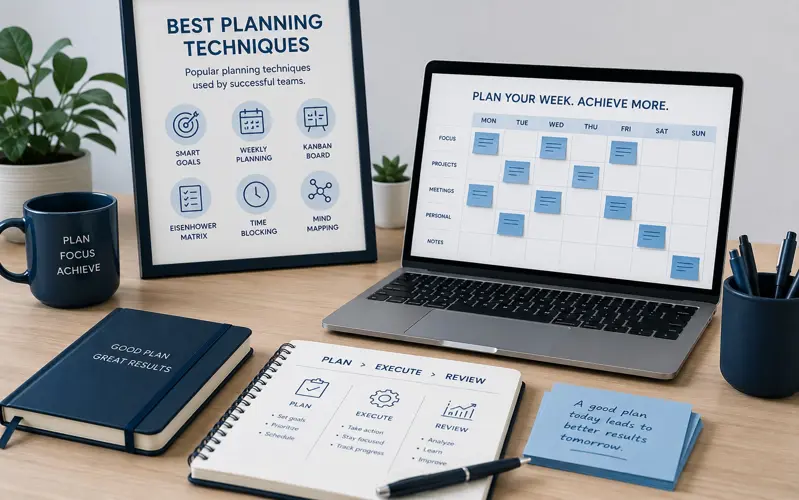
Best Planning Techniques: 15 Proven Methods to Improve Productivity and Project Success
Successful projects, productive teams, and well-organized businesses rarely depend on luck. Behind almost every successful organization is a structured planning process that helps people prioritize work, allocate resources, manage deadlines, and adapt to changing circumstances.
Planning techniques provide practical frameworks for organizing work before it begins. Instead of reacting to problems after they occur, effective planning helps identify priorities, estimate workloads, coordinate teams, and reduce risks long before they affect project outcomes.
Whether you manage software projects, construction work, marketing campaigns, manufacturing operations, or daily business activities, selecting the right planning technique can significantly improve productivity while reducing stress and unnecessary delays.
Modern organizations rarely rely on a single planning method. Instead, they often combine multiple techniques depending on project complexity, team size, available resources, and business objectives.
For example, a software development company may use Agile planning for product development, Kanban boards for daily task management, Gantt charts for release planning, and time blocking to help employees organize their daily schedules. Each technique solves a different planning challenge.
In this guide, we'll explore some of the most effective planning techniques used by businesses around the world, explain when each method works best, and provide practical examples that can help you improve both personal productivity and project management.
Why Planning Techniques Matter
Many projects fail not because employees lack technical skills, but because the work was never planned effectively. Poor planning often leads to missed deadlines, duplicated effort, unclear responsibilities, overloaded employees, and unnecessary costs.
A structured planning process helps organizations:
- Clarify priorities.
- Allocate resources efficiently.
- Reduce project risks.
- Improve communication.
- Track progress consistently.
- Manage deadlines.
- Increase productivity.
- Improve decision-making.
Planning also creates greater confidence across the organization because employees understand what needs to be accomplished and how their work supports larger business goals.
How to Choose the Right Planning Technique
No single planning technique works for every project. The best choice depends on the type of work being performed, the number of people involved, the level of uncertainty, and how frequently priorities change.
When selecting a planning method, consider questions such as:
- Does the project have fixed deadlines?
- How often do priorities change?
- How many people are involved?
- Are tasks dependent on one another?
- Do customers frequently request changes?
- How important is long-term scheduling?
- Does the team work remotely?
Answering these questions makes it much easier to identify planning techniques that match your workflow.
Technique 1: Goal-Oriented Planning
Goal-oriented planning begins by defining the desired outcome before deciding which activities should be performed.
Instead of creating a long task list immediately, planners first identify what success looks like. Every subsequent task, milestone, and deadline supports that objective.
For example, rather than writing:
- Create documentation.
- Schedule meetings.
- Develop software.
a goal-oriented plan starts with:
Launch the new customer portal by September 30.
Tasks are then organized around achieving that specific objective.
Goal-oriented planning helps teams remain focused on outcomes instead of simply staying busy.
Technique 2: Backward Planning
Backward planning starts with the final deadline and works backward to identify every milestone required along the way.
This technique is particularly useful when deadlines cannot change.
For example, imagine a company preparing for a product launch on December 1. Working backward might produce a schedule like this:
| Date | Milestone |
|---|---|
| December 1 | Product launch |
| November 20 | Final testing completed |
| November 10 | Marketing materials approved |
| October 25 | Development completed |
| October 1 | Project begins |
Planning backward ensures that every intermediate milestone supports the final delivery date.
Technique 3: Time Blocking
Time blocking is one of the simplest yet most effective productivity techniques.
Instead of maintaining a long to-do list, employees reserve specific blocks of time for different categories of work.
A daily schedule might include:
| Time | Activity |
|---|---|
| 08:30 – 10:00 | Project work |
| 10:00 – 10:30 | |
| 10:30 – 12:00 | Customer meetings |
| 13:00 – 15:00 | Focused work |
| 15:00 – 16:00 | Planning and follow-up |
Time blocking reduces multitasking, improves concentration, and helps employees protect time for their most important work.
Technique 4: Priority Matrix Planning
Not every task deserves immediate attention. Priority matrix planning helps teams distinguish between urgent activities and truly important work.
A common approach divides tasks into four categories:
| Urgent | Not Urgent |
|---|---|
| Do immediately. | Schedule for later. |
| Delegate if possible. | Eliminate if unnecessary. |
Using a priority matrix prevents employees from spending entire days responding to minor requests while neglecting strategic objectives.
Technique 5: Weekly Planning
Weekly planning provides a broader perspective than daily planning by organizing an entire week's priorities before work begins.
Managers review project milestones, customer commitments, meetings, employee availability, and deadlines before assigning work.
This proactive approach improves workload balance while reducing scheduling conflicts throughout the week.
For a complete step-by-step process, read Weekly Planning Guide.
If you'd like to improve your daily organization, continue with Daily Planning Guide.
You may also find Project Planning Step by Step helpful for understanding how structured planning supports successful project delivery.
Technique 6: Kanban Planning
Kanban is one of the most widely used planning techniques for managing ongoing work. Instead of organizing projects around fixed schedules, Kanban focuses on visualizing workflow and helping teams complete tasks continuously.
A typical Kanban board contains columns representing different stages of work, such as:
- Backlog.
- To Do.
- In Progress.
- Review.
- Completed.
Each task is represented by a card that moves across the board as work progresses.
Kanban offers several important advantages:
- Excellent visibility.
- Easy prioritization.
- Reduced multitasking.
- Improved collaboration.
- Continuous workflow management.
- Quick adaptation to changing priorities.
Because new tasks can be added at any time, Kanban is particularly effective for customer support teams, software maintenance, marketing departments, HR teams, and operational environments where priorities change frequently.
Unlike detailed project schedules, Kanban emphasizes completing work before starting additional tasks, reducing work in progress and improving delivery speed.
Technique 7: Gantt Chart Planning
While Kanban focuses on workflow, Gantt charts focus on scheduling.
A Gantt chart displays tasks along a timeline, making it easy to understand when activities begin, when they finish, how they depend on one another, and whether the project remains on schedule.
Project managers frequently use Gantt charts to:
- Plan milestones.
- Track deadlines.
- Manage dependencies.
- Allocate resources.
- Forecast project completion.
- Communicate schedules to stakeholders.
Construction, engineering, consulting, manufacturing, and product development projects often rely on Gantt charts because many activities cannot begin until earlier work has been completed.
Although maintaining a Gantt schedule requires regular updates, it provides one of the clearest long-term views available in project management.
Technique 8: Agile Planning
Agile planning recognizes that projects rarely unfold exactly as expected. Instead of attempting to define every detail months in advance, Agile divides work into smaller planning cycles that allow teams to adapt continuously.
Rather than creating one large project plan, Agile teams repeatedly:
- Review priorities.
- Estimate upcoming work.
- Deliver small improvements.
- Collect customer feedback.
- Adjust future plans.
This iterative approach reduces risk because problems are discovered earlier, customers receive value more quickly, and teams remain flexible when requirements evolve.
Agile planning is especially popular in software development but has also been adopted by marketing, product management, research, and innovation teams.
Technique 9: Rolling Wave Planning
Some projects are too large or uncertain to plan in complete detail from the very beginning. Rolling Wave Planning addresses this challenge by planning near- term work in detail while leaving future activities at a higher level until more information becomes available.
For example, during the first month of a year-long project, managers may define daily tasks for the next four weeks while describing later project phases only as major milestones.
As the project progresses, future work is gradually planned in greater detail.
This technique offers several advantages:
- Greater flexibility.
- More accurate planning.
- Reduced uncertainty.
- Improved decision-making.
- Better response to changing requirements.
Rolling Wave Planning is commonly used in engineering, construction, manufacturing, and large software implementations where many decisions depend on earlier project outcomes.
Technique 10: Resource Planning
Even the best project schedule cannot succeed without sufficient people, equipment, budgets, and materials.
Resource planning focuses on ensuring that required resources are available when work needs to be performed.
Managers typically evaluate:
- Employee availability.
- Required skills.
- Equipment usage.
- Vacation schedules.
- Budget limitations.
- Supplier availability.
Effective resource planning reduces bottlenecks while preventing employees from becoming overloaded.
Organizations managing multiple projects often perform resource planning every week to balance workloads across departments.
Combining Multiple Planning Techniques
The most successful organizations rarely rely on a single planning technique. Instead, they combine several complementary methods depending on the type of work being performed.
For example, a product development company might:
- Use goal-oriented planning to define business objectives.
- Create a Gantt chart for the overall release schedule.
- Manage daily development work with Kanban.
- Organize software delivery using Agile sprints.
- Balance employee workloads through resource planning.
- Help individuals organize their day using time blocking.
Each technique addresses a different aspect of planning, creating a more complete management system.
Choosing Techniques Based on Project Type
| Project Type | Recommended Techniques |
|---|---|
| Software Development | Agile, Kanban, Time Blocking |
| Construction | Gantt, Resource Planning, Backward Planning |
| Marketing Campaigns | Weekly Planning, Kanban, Goal-Oriented Planning |
| Manufacturing | Resource Planning, Gantt, Rolling Wave Planning |
| Consulting | Weekly Planning, Time Blocking, Gantt |
| Customer Support | Kanban, Daily Planning, Priority Matrix |
Example: Launching a New Product
Imagine a company preparing to launch a new software product.
Executives begin by defining the business objective using goal-oriented planning. Project managers then create a Gantt chart that establishes major milestones, deadlines, and dependencies.
Development teams organize their daily work using Kanban boards while following Agile planning cycles that deliver new features every few weeks.
Meanwhile, department managers review employee availability through resource planning and individuals organize their daily schedules using time blocking.
Instead of relying on one planning system, every technique contributes to the overall success of the project.
For a detailed comparison between visual planning methods, read Kanban vs Gantt: Which Planning Method Is Better?.
To learn more about allocating people across projects, continue with Resource Management: The Complete Guide.
You may also find Workload Management: The Complete Guide helpful for balancing assignments across teams while avoiding employee overload.
Technique 11: Critical Path Method (CPM)
The Critical Path Method (CPM) is one of the most effective planning techniques for managing complex projects with many dependent activities. Rather than viewing tasks individually, CPM identifies the sequence of activities that directly determines the project's completion date.
These activities form the critical path. If any task on this path is delayed, the entire project will finish later unless corrective action is taken.
Project managers typically use CPM to:
- Identify critical tasks.
- Understand project dependencies.
- Allocate resources efficiently.
- Monitor schedule risks.
- Prioritize activities that affect deadlines.
Construction projects, engineering programs, infrastructure development, and large manufacturing initiatives frequently use the Critical Path Method because their schedules contain many interdependent activities.
Technique 12: Scenario Planning
Business environments constantly change. Customers adjust priorities, competitors introduce new products, regulations evolve, and economic conditions shift unexpectedly.
Scenario planning prepares organizations for multiple possible futures instead of assuming that only one plan will succeed.
A planning team may develop several scenarios:
- Best-case scenario.
- Expected scenario.
- Worst-case scenario.
- Rapid growth scenario.
- Budget reduction scenario.
Each scenario includes different assumptions, risks, and response strategies. If circumstances change, managers can react much faster because alternative plans already exist.
Scenario planning is especially valuable for strategic planning, budgeting, business continuity, and long-term investments.
Technique 13: SWOT Planning
SWOT planning helps organizations evaluate internal and external factors before making important decisions.
The acronym stands for:
| Letter | Meaning |
|---|---|
| S | Strengths |
| W | Weaknesses |
| O | Opportunities |
| T | Threats |
By evaluating these four areas before planning begins, organizations make better strategic decisions while reducing unnecessary risk.
SWOT planning is commonly used before launching new products, entering new markets, expanding operations, or beginning major projects.
Technique 14: Risk-Based Planning
Every project contains uncertainty. Risk-based planning identifies potential problems before they occur and develops strategies for minimizing their impact.
Rather than assuming everything will proceed exactly as planned, project teams actively evaluate possible risks throughout the planning process.
Typical project risks include:
- Supplier delays.
- Budget overruns.
- Resource shortages.
- Technical problems.
- Changing customer requirements.
- Regulatory changes.
- Weather conditions.
Once risks have been identified, managers estimate both the likelihood of each risk and its potential impact before preparing mitigation plans.
Organizations that regularly perform risk-based planning are generally better prepared to maintain project schedules even when unexpected challenges arise.
Technique 15: Collaborative Planning
Traditional planning often depended on a single project manager creating the entire project schedule. Modern organizations increasingly use collaborative planning instead.
Employees, managers, customers, suppliers, and stakeholders contribute their knowledge during the planning process, creating more realistic schedules and improving overall commitment.
Collaborative planning offers several advantages:
- Better communication.
- More accurate estimates.
- Greater employee engagement.
- Improved transparency.
- Faster problem solving.
- Higher project ownership.
Digital planning platforms make collaborative planning much easier because multiple people can update tasks, schedules, comments, and project information in real time.
Comparison of Planning Techniques
| Technique | Best Used For |
|---|---|
| Goal-Oriented Planning | Business objectives |
| Backward Planning | Fixed deadlines |
| Time Blocking | Personal productivity |
| Priority Matrix | Task prioritization |
| Weekly Planning | Weekly organization |
| Kanban | Workflow management |
| Gantt Chart | Project scheduling |
| Agile Planning | Iterative projects |
| Rolling Wave Planning | Long-term projects |
| Resource Planning | Workload balancing |
| Critical Path Method | Complex scheduling |
| Scenario Planning | Strategic planning |
| SWOT Planning | Business analysis |
| Risk-Based Planning | Project risk management |
| Collaborative Planning | Team coordination |
Common Planning Mistakes
Even the best planning technique cannot compensate for poor planning habits. Organizations should avoid mistakes such as:
- Creating unrealistic schedules.
- Ignoring project risks.
- Failing to prioritize work.
- Overloading employees.
- Not updating plans regularly.
- Poor communication.
- Ignoring task dependencies.
- Planning without measurable goals.
- Using the same planning method for every project.
- Not reviewing project progress.
Regular reviews and continuous improvement help organizations get the greatest value from any planning technique.
Frequently Asked Questions
Which planning technique is best?
There is no single best technique. The right choice depends on the project, team size, deadlines, and business objectives. Many organizations combine multiple planning methods.
Can I use several planning techniques together?
Yes. Combining methods such as Gantt charts, Kanban boards, time blocking, and resource planning often produces better results than relying on only one approach.
Which planning technique is easiest to learn?
Time blocking, weekly planning, and Kanban are generally the easiest methods for beginners because they require minimal setup while delivering immediate benefits.
Which planning technique is best for large projects?
Large projects usually benefit from combining Gantt charts, Critical Path Method, resource planning, and risk-based planning.
Do planning techniques improve productivity?
Yes. Effective planning reduces wasted time, improves prioritization, enhances communication, and helps teams complete projects more consistently.
Related Articles
- Project Planning Step by Step
- Project Management: The Complete Guide
- Kanban vs Gantt: Which Planning Method Is Better?
- Daily Planning Guide
- Weekly Planning Guide
- Task Management: The Complete Guide
- Resource Management: The Complete Guide
- Workload Management: The Complete Guide
- How to Track Project Progress Effectively
- Team Collaboration Guide
Final Thoughts
Planning techniques provide practical frameworks for turning business goals into achievable results. Whether you are organizing daily work, coordinating large projects, managing multiple teams, or developing long-term business strategies, choosing the right planning approach improves productivity, communication, and decision-making.
The most successful organizations understand that no single technique solves every planning challenge. Instead, they combine complementary methods such as goal-oriented planning, Gantt charts, Kanban boards, Agile planning, resource planning, and risk management to create flexible yet structured workflows that can adapt as priorities evolve.
MyPlannerDesk brings these planning techniques together in one integrated platform. Teams can organize projects with Gantt charts, manage daily work using Kanban boards, schedule tasks through shared calendars, balance workloads, track time, allocate resources, monitor progress with dashboards, and collaborate in real time. Instead of switching between multiple applications, project managers and employees can plan, execute, and monitor their work from a single workspace.
Whether you lead a small business, coordinate enterprise projects, or simply want to become more organized, applying the right planning techniques will help you improve productivity, reduce project risk, and deliver better results with greater confidence.