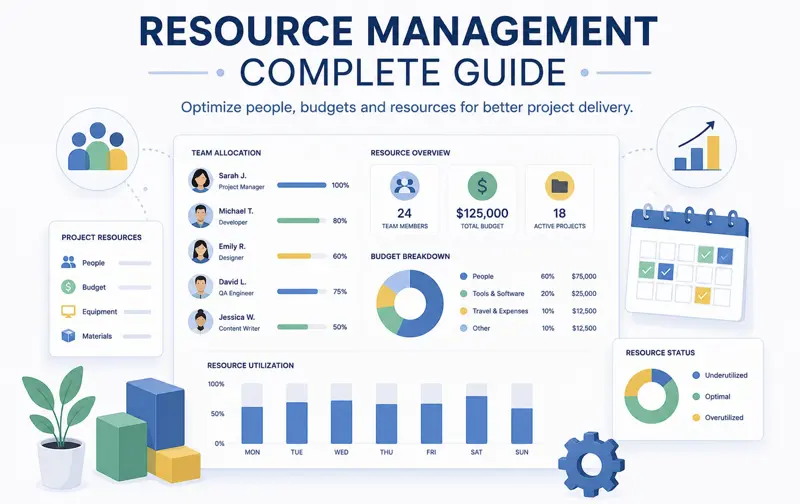
Resource Management: The Complete Guide to Planning, Allocating, and Optimizing Project Resources
Successful projects are rarely completed because of luck. They succeed because the right people, equipment, budget, and time are available when they are needed. Coordinating all of these elements is known as resource management.
Whether your organization manages five projects or hundreds of simultaneous initiatives, effective resource management ensures that work is completed efficiently without overloading employees, delaying projects, or wasting valuable business resources.
Many organizations initially manage resources using spreadsheets, emails, and manual planning. While these methods may work for small teams, they quickly become difficult to maintain as projects grow more complex and departments become increasingly interconnected.
Modern resource management software gives managers complete visibility into employee availability, workloads, project schedules, equipment usage, budgets, and future capacity. Instead of reacting to problems after they occur, organizations can make proactive decisions based on accurate, real-time data.
This guide explains the principles of resource management, resource planning, allocation strategies, utilization metrics, forecasting techniques, and best practices that help organizations complete projects on time while maximizing productivity.
What Is Resource Management?
Resource management is the process of planning, assigning, monitoring, and optimizing all resources required to complete business operations or projects.
Resources include far more than employees. Organizations must also manage equipment, meeting rooms, software licenses, vehicles, budgets, materials, and other assets needed to deliver successful outcomes.
The objective is simple:
- Use resources efficiently.
- Avoid conflicts.
- Prevent overload.
- Reduce idle capacity.
- Improve project delivery.
- Increase profitability.
When resources are planned effectively, teams spend less time resolving conflicts and more time delivering value.
Types of Project Resources
Every organization relies on different resource types. Understanding these categories makes planning significantly easier.
| Resource Type | Examples |
|---|---|
| Human Resources | Employees, consultants, contractors. |
| Equipment | Laptops, machinery, vehicles, tools. |
| Facilities | Meeting rooms, offices, warehouses. |
| Financial Resources | Budgets, project funding. |
| Technology | Software licenses, cloud services. |
| Materials | Construction materials, inventory, supplies. |
Managing these resources together provides managers with a complete picture of project readiness.
Why Resource Management Matters
Poor resource management often leads to delayed projects, frustrated employees, budget overruns, and dissatisfied customers.
Common problems include assigning the same employee to multiple projects, booking equipment twice, exceeding project budgets, or discovering too late that critical skills are unavailable.
Organizations with mature resource management practices typically experience:
- Better project planning.
- Higher employee productivity.
- Lower operational costs.
- Improved customer satisfaction.
- Fewer scheduling conflicts.
- Better resource utilization.
- More predictable project delivery.
Resource Planning
Resource planning is the process of determining which resources will be needed, when they will be needed, and how long they will be required.
Planning should begin before a project starts rather than after work has already been assigned.
Managers should answer questions such as:
- How many people are required?
- Which skills are necessary?
- What equipment must be reserved?
- What budget is available?
- Which departments will participate?
- Are external contractors needed?
Careful planning reduces surprises later in the project lifecycle.
Resource Allocation
Once resources have been identified, they must be assigned appropriately. Resource allocation ensures that every task is completed by the most suitable resource while considering availability, skills, workload, and project priorities.
Effective allocation is based on several factors:
- Employee expertise.
- Current workload.
- Project deadlines.
- Business priorities.
- Estimated effort.
- Resource availability.
Assigning work solely based on availability often results in reduced quality and inefficient project execution.
Avoid Resource Overallocation
One of the most common project management problems is overallocation. This occurs when the same employee or resource is assigned more work than can reasonably be completed within the available time.
For example, a software developer scheduled for forty hours of work may accidentally receive assignments totaling sixty hours during the same week. Without visibility into workloads, these conflicts may remain hidden until deadlines begin to slip.
Modern planning tools automatically highlight overallocation so managers can redistribute work before projects are affected.
Identify Underutilized Resources
While overload attracts immediate attention, underutilized resources can be equally costly. Employees with consistently low workloads represent unused capacity that could support other projects.
Managers should regularly identify:
- Available employees.
- Idle equipment.
- Unused meeting rooms.
- Unassigned budgets.
- Departments with spare capacity.
Making better use of existing resources often eliminates the need for additional hiring or unnecessary purchases.
Resource Utilization
Resource utilization measures how effectively available resources are being used.
Healthy utilization is not the same as maximum utilization. Keeping every employee busy one hundred percent of the time leaves no flexibility for urgent work, customer requests, meetings, or unexpected issues.
| Utilization | Interpretation |
|---|---|
| Below 60% | Resources may be underused. |
| 60–80% | Healthy workload. |
| 80–90% | High utilization. |
| Above 90% | Risk of overload. |
Resource Management Example
Imagine an engineering company managing several construction projects at the same time.
Each project requires structural engineers, architects, surveyors, machinery, vehicles, and specialized equipment.
Without centralized resource management, multiple project managers may reserve the same crane or assign the same engineer to overlapping projects.
By using a shared resource management system, managers immediately see resource availability and can avoid scheduling conflicts before work begins.
If your organization also manages employee capacity, continue with our guide Workload Management: The Complete Guide .
You may also benefit from reading Project Management: The Complete Guide , which explains how effective resource planning contributes to successful project delivery.
Resource Scheduling
Resource scheduling is the process of determining exactly when each resource will be used throughout a project. While resource planning identifies what is needed, scheduling determines when those resources will perform specific work.
Effective scheduling reduces idle time while preventing conflicts between projects competing for the same employees or equipment.
Managers should schedule resources by considering:
- Project priorities.
- Employee availability.
- Required skills.
- Equipment availability.
- Customer deadlines.
- Business holidays.
A centralized scheduling system makes it much easier to coordinate multiple projects running simultaneously.
Capacity Planning
Capacity planning helps organizations determine whether available resources are sufficient to meet future demand.
Rather than waiting until projects are delayed, managers estimate future capacity requirements and adjust staffing levels before shortages occur.
Questions addressed during capacity planning include:
- Do we have enough employees?
- Will equipment availability become a bottleneck?
- Can existing teams support additional projects?
- Should contractors be hired?
- Will vacations affect delivery schedules?
Capacity planning improves long-term business stability by reducing unexpected resource shortages.
Resource Forecasting
Forecasting predicts future resource demand using historical data, project pipelines, seasonal trends, and business growth plans.
Organizations that forecast accurately can prepare resources before demand increases rather than reacting after problems arise.
Typical forecasting inputs include:
- Upcoming sales opportunities.
- Project backlog.
- Historical workload trends.
- Seasonal demand.
- Customer contracts.
- Planned hiring.
Forecasting improves budgeting while reducing emergency staffing decisions.
Resource Leveling
Resource leveling is a project management technique used when resource demand exceeds available capacity.
Instead of expecting employees to work excessive overtime, managers adjust the project schedule to create a more realistic workload.
Common leveling strategies include:
- Postponing lower-priority tasks.
- Extending project timelines.
- Assigning additional employees.
- Splitting work across multiple teams.
- Reducing project scope.
Resource leveling focuses on protecting employees from overload while ensuring that critical work continues moving forward.
Resource Smoothing
Resource smoothing differs from leveling because project deadlines remain fixed. Instead of changing delivery dates, managers redistribute available resources to balance workloads while preserving the original schedule.
This technique is commonly used when deadlines cannot be changed because of customer commitments or contractual obligations.
Examples include:
- Moving tasks between team members.
- Reordering activities.
- Adjusting daily priorities.
- Using available specialists.
- Increasing collaboration across departments.
Track Resource Availability
Resource availability changes constantly. Employees take vacations, attend training sessions, become involved in urgent projects, or support customers. Equipment may require maintenance, and meeting rooms may already be reserved.
Managers should maintain a real-time resource calendar that clearly shows:
- Available employees.
- Approved leave.
- Training schedules.
- Equipment reservations.
- Department capacity.
- Upcoming commitments.
Having current availability information reduces planning errors and scheduling conflicts.
Important Resource Management KPIs
Monitoring key performance indicators helps managers evaluate how effectively resources are being used.
| KPI | Purpose |
|---|---|
| Resource Utilization | Measures how effectively resources are used. |
| Capacity Utilization | Shows remaining available capacity. |
| Resource Availability | Tracks future resource availability. |
| Schedule Conflicts | Measures planning quality. |
| Project Delay Rate | Shows impact of resource shortages. |
| Overtime Hours | Identifies excessive workloads. |
Example: Software Development Company
A software company develops several applications simultaneously. Developers, UX designers, testers, and DevOps engineers are shared across multiple projects.
Without centralized resource management, the same senior developer may be scheduled for critical work on two projects during the same week.
By implementing resource scheduling software, project managers immediately see availability conflicts and redistribute assignments before development begins. This prevents delays while reducing employee stress.
Example: Manufacturing Business
A manufacturing company depends on production lines, specialized machinery, maintenance teams, and warehouse staff.
By forecasting demand and scheduling equipment maintenance during quieter periods, production continues with minimal interruption while reducing costly downtime.
Example: Marketing Agency
A marketing agency manages SEO campaigns, content creation, advertising, graphic design, and social media for dozens of clients.
Using workload dashboards together with resource planning allows managers to assign campaigns according to employee availability and expertise instead of simply distributing work evenly.
This improves delivery quality while preventing creative teams from becoming overloaded during busy periods.
Integrating Resource Management With Other Processes
Resource management delivers the greatest value when integrated with project management, task management, employee scheduling, and leave management.
Instead of maintaining separate spreadsheets for each activity, organizations benefit from one centralized platform where managers can see:
- Project timelines.
- Employee workloads.
- Vacation schedules.
- Task assignments.
- Equipment reservations.
- Available capacity.
- Project budgets.
This unified approach improves collaboration and reduces administrative work.
To learn more about balancing employee capacity, read Workload Management: The Complete Guide .
You may also find Employee Scheduling: The Complete Guide helpful for coordinating people and project resources efficiently.
Resource Management Best Practices
Effective resource management is not only about assigning employees to projects. It requires continuous monitoring, regular communication, and proactive planning to ensure that every resource is used efficiently without creating unnecessary pressure on the team.
Organizations that consistently follow resource management best practices deliver projects more predictably, reduce operational costs, and improve both employee and customer satisfaction.
- Create a resource plan before every project.
- Review resource availability weekly.
- Assign work based on skills, not only availability.
- Monitor workloads continuously.
- Track vacations and public holidays.
- Maintain accurate project schedules.
- Forecast future resource demand.
- Avoid excessive overtime.
- Use dashboards for visibility.
- Review resource utilization monthly.
Common Resource Management Mistakes
Many project delays originate from poor resource planning rather than technical problems. Understanding common mistakes helps organizations improve planning and avoid unnecessary disruptions.
- Assigning one employee to multiple critical projects.
- Ignoring employee availability.
- Failing to forecast future demand.
- Planning projects without checking resource capacity.
- Booking equipment twice.
- Ignoring recurring operational work.
- Not updating project schedules.
- Using disconnected spreadsheets.
- Ignoring employee burnout.
- Monitoring projects instead of resources.
Recognizing these issues early enables managers to take corrective action before projects are affected.
Benefits of Resource Management Software
As organizations grow, managing resources manually becomes increasingly difficult. Modern resource management software centralizes planning and provides real-time visibility into every important aspect of project execution.
Typical software capabilities include:
- Resource calendars.
- Capacity planning.
- Project timelines.
- Employee scheduling.
- Task assignments.
- Kanban boards.
- Workload dashboards.
- Leave management.
- Budget tracking.
- Performance reports.
Having all resource information available in one place allows managers to make faster and more informed decisions.
Real-World Example: Engineering Company
An engineering firm manages infrastructure projects across several cities. Structural engineers, surveyors, project managers, and specialized equipment must be coordinated carefully to avoid delays.
Before implementing centralized resource management, project managers frequently competed for the same employees and machinery. Scheduling conflicts often appeared only after projects had already started.
After introducing a shared resource planning platform, every department gained visibility into employee availability, equipment reservations, and project timelines. Resource conflicts decreased significantly, and projects were completed with fewer delays.
Real-World Example: Healthcare Organization
Hospitals and healthcare providers face constant challenges in managing doctors, nurses, operating rooms, and medical equipment.
By integrating employee scheduling with resource management, administrators can ensure that qualified staff and required equipment are available whenever patients require treatment.
This improves operational efficiency while helping maintain a high standard of patient care.
Resource Management Checklist
- Identify required project resources.
- Review employee availability.
- Verify required skills.
- Reserve necessary equipment.
- Estimate project effort.
- Create a resource schedule.
- Balance workloads.
- Monitor capacity utilization.
- Track vacations and leave.
- Review project priorities.
- Forecast future resource demand.
- Monitor resource conflicts.
- Track equipment availability.
- Review project progress weekly.
- Analyze utilization reports.
- Identify bottlenecks.
- Redistribute overloaded resources.
- Communicate schedule changes.
- Update resource calendars.
- Collect team feedback.
- Review KPIs monthly.
- Improve planning processes continuously.
Frequently Asked Questions
What is resource management?
Resource management is the process of planning, allocating, scheduling, and monitoring people, equipment, budgets, and other resources required to complete projects successfully.
Why is resource management important?
It helps organizations optimize resource utilization, prevent scheduling conflicts, reduce project delays, improve productivity, and control costs.
What is the difference between resource planning and resource scheduling?
Resource planning determines what resources are required, while resource scheduling determines exactly when those resources will be used.
What is resource utilization?
Resource utilization measures how effectively available resources are being used. Healthy utilization balances productivity with sufficient flexibility to handle unexpected work.
What is capacity planning?
Capacity planning evaluates whether current resources are sufficient to meet future project demands and business growth.
How often should resource plans be reviewed?
Most organizations review resource plans weekly, while large projects may require daily monitoring.
Can resource management reduce project delays?
Yes. Identifying conflicts and shortages before work begins significantly reduces the likelihood of missed deadlines and unexpected disruptions.
Which industries benefit from resource management?
Almost every industry benefits, including software development, construction, manufacturing, healthcare, finance, consulting, logistics, education, and marketing.
Related Articles
- Project Management: The Complete Guide
- Project Planning Step by Step
- Workload Management: The Complete Guide
- Employee Scheduling: The Complete Guide
- Employee Leave Management: The Complete Guide
- Task Management: The Complete Guide
- Kanban Board: The Complete Guide
- How to Track Project Progress Effectively
- How to Reduce Project Delays
- Time Management: The Complete Guide
Final Thoughts
Resource management is the foundation of successful project execution. No matter how well a project is planned, it cannot succeed if the necessary people, equipment, and budgets are unavailable at the right time.
Organizations that actively plan, allocate, monitor, and optimize their resources achieve higher productivity, improve employee satisfaction, reduce costs, and deliver projects more consistently.
As businesses expand, relying on spreadsheets and manual planning becomes increasingly difficult. A centralized resource management platform provides the visibility managers need to coordinate employees, equipment, schedules, and project priorities across the entire organization.
MyPlannerDesk combines Resource Management, Project Planning, Task Management, Kanban Boards, Gantt Charts, Workload Management, Employee Scheduling, Leave Management, Shared Calendars, and Reporting into one integrated platform. Managers can instantly view resource availability, identify overallocation, balance workloads, assign tasks based on skills, and monitor project progress from a single dashboard.
Whether you manage a growing startup or a large enterprise with multiple departments, investing in effective resource management will help your team deliver projects faster, improve collaboration, reduce operational risks, and make better business decisions based on real-time information.