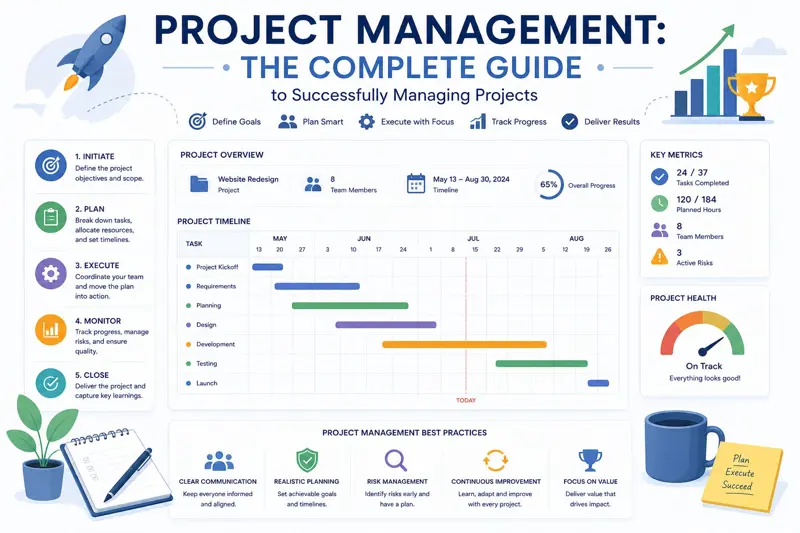
Project Management: The Complete Guide to Successfully Managing Projects
Successful organizations rarely complete projects by accident. Whether the goal is launching a new product, implementing business software, constructing a building, or organizing a marketing campaign, every successful project follows a structured management process.
Unfortunately, many businesses still manage projects using spreadsheets, multiple email conversations, sticky notes, and disconnected documents. As projects become larger and involve more people, these methods quickly become difficult to manage.
Missed deadlines, unclear responsibilities, communication problems, and uncontrolled workloads become increasingly common.
Project management provides a structured approach that helps teams organize their work, assign responsibilities, monitor progress, manage risks, and deliver successful results within the planned schedule and budget.
This comprehensive guide explains the complete project management process, from planning and execution to monitoring and project closure. Whether you manage small internal projects or large business initiatives, these principles will help improve organization, productivity, and project success.
What Is Project Management?
Project management is the process of planning, organizing, coordinating, executing, monitoring, and completing a project while achieving defined objectives within agreed constraints such as time, budget, and available resources.
Unlike everyday operational work, projects have a clear beginning and end. Every project is created to achieve a specific objective.
Examples include:
- Developing a new software application.
- Launching a company website.
- Opening a new office location.
- Implementing an ERP system.
- Organizing a business conference.
- Creating a new marketing campaign.
Each project requires planning, coordination, communication, and continuous monitoring throughout its lifecycle.
Why Project Management Is Important
Without proper project management, organizations often experience delays, budget overruns, duplicated work, unclear priorities, and dissatisfied customers.
A structured project management approach helps organizations:
- Deliver projects on schedule.
- Control project costs.
- Improve communication.
- Assign responsibilities clearly.
- Reduce project risks.
- Increase team productivity.
- Improve customer satisfaction.
Project management creates transparency by ensuring that everyone understands what needs to be done, who is responsible, and when work should be completed.
The Five Phases of Project Management
Most successful projects follow five fundamental phases throughout their lifecycle.
| Phase | Purpose |
|---|---|
| Initiation | Define project goals and feasibility. |
| Planning | Create schedules, budgets, resources, and task plans. |
| Execution | Perform project work and coordinate the team. |
| Monitoring & Control | Track progress, risks, quality, and deadlines. |
| Closure | Complete deliverables and evaluate project success. |
Skipping one of these phases often creates problems later in the project. Organizations that consistently follow all five phases usually achieve more predictable outcomes.
Start With Clearly Defined Objectives
One of the biggest reasons projects fail is unclear objectives.
Employees cannot successfully complete work if they do not understand what the project is trying to achieve.
Every project should answer questions such as:
- What problem are we solving?
- What does success look like?
- Who is the customer?
- What is the deadline?
- What resources are available?
- What limitations exist?
Clearly defined objectives help prevent confusion throughout the project.
Define Project Scope
Project scope describes exactly what is included—and equally important—what is not included in the project.
Poorly defined scope often leads to scope creep, where additional work is gradually added without adjusting budgets or schedules.
For example, a website development project might include:
- Homepage.
- Product catalog.
- Contact page.
- Administrator dashboard.
- Responsive design.
It may intentionally exclude:
- Mobile application.
- Customer loyalty system.
- Multi-language support.
- Online payment integration.
Documenting project scope helps prevent misunderstandings and uncontrolled changes.
Identify Project Stakeholders
Every project involves people who influence or are affected by its outcome. These individuals are known as stakeholders.
Typical stakeholders include:
- Project sponsor.
- Project manager.
- Project team.
- Customers.
- Suppliers.
- Company management.
Understanding stakeholder expectations improves communication and reduces the risk of conflicts during project execution.
Create a Work Breakdown Structure (WBS)
Large projects become much easier to manage when divided into smaller, well-defined activities.
A Work Breakdown Structure (WBS) organizes the project into manageable sections.
For example, a website project could be divided into:
- Requirements Analysis.
- User Interface Design.
- Backend Development.
- Frontend Development.
- Testing.
- Deployment.
- User Training.
Breaking projects into smaller components improves planning accuracy while making progress easier to monitor.
Assign Roles and Responsibilities
One of the most common project management mistakes is assuming everyone knows who is responsible for each activity.
Every important task should have one clearly assigned owner.
Responsibility includes:
- Completing assigned work.
- Reporting progress.
- Identifying risks.
- Communicating delays.
- Maintaining quality.
Clear ownership improves accountability and prevents important work from being overlooked.
Example Project Structure
| Project Phase | Responsible Team | Status |
|---|---|---|
| Requirements | Business Analysts | Completed |
| Design | UI/UX Team | In Progress |
| Development | Software Team | Not Started |
| Testing | QA Team | Pending |
| Deployment | IT Operations | Pending |
A structured project overview allows managers to identify delays and monitor progress throughout the project lifecycle.
If you're new to project planning, continue with our guide Project Planning Step by Step, which explains how to build realistic project schedules.
You may also benefit from reading Task Management: The Complete Guide to Organizing Work Effectively, which explains how individual tasks contribute to overall project success.
Create a Realistic Project Schedule
Once the project scope has been defined and tasks have been identified, the next step is creating a realistic schedule. A project schedule transforms ideas into an actionable timeline by showing when each task should begin, when it should be completed, and how different activities depend on one another.
One of the most common reasons projects miss deadlines is unrealistic planning. Managers often underestimate the time required for complex work or forget to include testing, approvals, training, and unexpected delays.
A well-designed project schedule should include:
- Project milestones.
- Task start dates.
- Task due dates.
- Dependencies between tasks.
- Resource availability.
- Buffer time for unexpected issues.
Rather than creating aggressive schedules that leave no room for change, successful project managers build flexibility into their plans while still maintaining clear deadlines.
Use Gantt Charts for Timeline Planning
A Gantt chart is one of the most widely used project management tools because it provides a visual representation of the project timeline.
Each task appears as a horizontal bar that shows its planned duration. Team members can immediately understand when work starts, when it finishes, and how different activities relate to each other.
Gantt charts are particularly valuable for projects involving multiple teams, long schedules, and task dependencies.
Typical information shown on a Gantt chart includes:
- Project phases.
- Task durations.
- Milestones.
- Dependencies.
- Progress percentages.
- Assigned employees.
Because everything is displayed on a timeline, managers can quickly identify delays before they affect the overall project.
Understand Task Dependencies
Many project activities cannot begin until other work has been completed. Ignoring these relationships often creates unrealistic schedules.
For example, a software development project may require:
- Requirements before design.
- Design before development.
- Development before testing.
- Testing before deployment.
Understanding dependencies helps managers determine which activities can run in parallel and which must wait for earlier work to finish.
Manage Resources Effectively
Projects are completed by people, not schedules. Even the best project plan will fail if employees are overloaded or unavailable.
Resource management ensures that the right people are assigned to the right tasks at the right time.
Project managers should regularly review:
- Employee availability.
- Skills and expertise.
- Current workload.
- Vacation schedules.
- Business priorities.
- Project deadlines.
Balanced workloads reduce burnout while improving productivity and project quality.
Control Project Budgets
Successful projects deliver value while staying within financial constraints. Budget management begins during project planning and continues throughout the entire project lifecycle.
Typical project costs include:
- Employee salaries.
- External contractors.
- Software licenses.
- Equipment.
- Travel expenses.
- Training.
Managers should compare planned costs with actual spending throughout the project so corrective actions can be taken before budgets are exceeded.
Identify Risks Early
Every project involves uncertainty. Risk management helps organizations prepare for potential problems before they become expensive emergencies.
Common project risks include:
- Missed deadlines.
- Employee turnover.
- Supplier delays.
- Budget overruns.
- Technical problems.
- Changing customer requirements.
Each identified risk should include a mitigation plan describing how the team will reduce its likelihood or minimize its impact if it occurs.
Manage Project Changes Carefully
Projects rarely remain unchanged from beginning to end. Customers request new features, business priorities evolve, and technical challenges emerge.
Although change is inevitable, uncontrolled change—often called scope creep—is one of the leading causes of project failure.
Before accepting a change request, managers should evaluate:
- Business value.
- Additional cost.
- Schedule impact.
- Required resources.
- Technical feasibility.
Every approved change should be documented and communicated to the project team.
Keep Communication Centralized
Poor communication is responsible for countless project delays. Important information becomes scattered across emails, chat applications, phone calls, and personal notes.
Modern project management software keeps discussions connected directly to the relevant tasks and projects.
Instead of searching multiple communication channels, team members can easily find:
- Task comments.
- Project documents.
- Status updates.
- Decision history.
- File attachments.
- Activity logs.
Centralized communication improves transparency and reduces misunderstandings.
Monitor Project Performance
Project managers should regularly compare actual progress against the original plan.
Monitoring allows managers to identify problems early rather than waiting until project deadlines have already been missed.
| KPI | Purpose |
|---|---|
| Schedule Performance | Measures whether the project is on time. |
| Budget Performance | Compares planned and actual costs. |
| Task Completion Rate | Measures project progress. |
| Overdue Tasks | Identifies scheduling problems. |
| Resource Utilization | Evaluates employee workload. |
| Risk Status | Monitors unresolved project risks. |
Regular performance reviews allow managers to make informed decisions before small issues become major project problems.
If your projects frequently miss deadlines, continue reading How to Reduce Project Delays .
You may also benefit from our guide Time Management: The Complete Guide to Improving Productivity at Work , which explains techniques for improving individual and team productivity.
Choose the Right Project Management Methodology
Every project is different, which means there is no single project management methodology that works perfectly in every situation.
Successful project managers choose the approach that best matches the project's size, complexity, customer expectations, and business goals.
The three most common approaches are:
- Traditional Waterfall Project Management.
- Agile Project Management.
- Kanban-based Project Management.
Waterfall Project Management
The Waterfall methodology follows a sequential process where each phase is completed before the next begins.
Typical stages include:
- Requirements.
- Design.
- Implementation.
- Testing.
- Deployment.
- Maintenance.
Waterfall works best when project requirements are clearly defined and are unlikely to change during execution.
Examples include construction projects, manufacturing, infrastructure development, and regulatory compliance projects.
Agile Project Management
Agile focuses on flexibility, collaboration, and continuous improvement. Instead of delivering one large project at the end, Agile teams work in short development cycles called sprints.
Each sprint produces working results that can be reviewed by stakeholders and improved based on feedback.
Benefits of Agile include:
- Faster customer feedback.
- Greater flexibility.
- Improved collaboration.
- Continuous delivery.
- Reduced project risk.
Agile is especially popular in software development, digital marketing, product development, and technology startups.
Using Kanban to Visualize Work
Kanban is one of the simplest and most effective ways to manage project tasks. Instead of focusing primarily on schedules, Kanban visualizes the current flow of work.
A typical Kanban board includes columns such as:
- To Do
- In Progress
- Review
- Completed
As work progresses, tasks move across the board, giving every team member an instant understanding of project status.
Kanban works particularly well for support teams, software development, marketing departments, and ongoing operational work.
Conduct Regular Project Reviews
Projects should never operate on autopilot. Regular review meetings help teams identify problems early, celebrate completed milestones, and adjust plans when necessary.
Weekly project reviews typically include:
- Completed work.
- Upcoming milestones.
- Current risks.
- Blocked tasks.
- Budget status.
- Resource availability.
Short, focused review meetings are usually far more effective than infrequent long meetings.
Complete a Lessons Learned Review
Every completed project provides valuable experience that can improve future projects.
Before officially closing a project, teams should discuss:
- What went well?
- What caused delays?
- Which risks occurred?
- Which estimates were inaccurate?
- What should be repeated next time?
- What should be improved?
Organizations that consistently document lessons learned continuously improve their project management maturity.
Project Management Best Practices
- Define clear project goals.
- Create realistic schedules.
- Break projects into manageable tasks.
- Assign ownership for every task.
- Communicate regularly.
- Track project progress continuously.
- Manage risks proactively.
- Monitor employee workloads.
- Document important decisions.
- Review project performance frequently.
Project Management Checklist
- Define project objectives.
- Identify stakeholders.
- Create a project scope document.
- Break work into tasks.
- Estimate durations.
- Create a project schedule.
- Assign responsibilities.
- Allocate resources.
- Identify project risks.
- Prepare contingency plans.
- Define milestones.
- Monitor budgets.
- Track task completion.
- Update project documentation.
- Review workload regularly.
- Conduct weekly status meetings.
- Monitor KPIs.
- Collect customer feedback.
- Perform lessons learned.
- Archive project documentation.
Frequently Asked Questions
What is project management?
Project management is the structured process of planning, organizing, executing, monitoring, and completing projects while meeting defined goals, deadlines, and budgets.
Why is project management important?
It improves organization, reduces delays, controls costs, improves communication, and increases the likelihood of successful project delivery.
What are the five phases of project management?
Initiation, Planning, Execution, Monitoring and Control, and Closure.
What is the difference between Agile and Waterfall?
Waterfall follows sequential phases, while Agile delivers work in smaller, iterative cycles that allow continuous improvement.
What is a Gantt chart?
A Gantt chart is a timeline-based planning tool used to visualize project schedules, milestones, task durations, and dependencies.
What is a Kanban board?
A Kanban board visually tracks work by moving tasks through workflow stages such as To Do, In Progress, Review, and Completed.
How do you reduce project risks?
Identify risks early, evaluate their impact, prepare mitigation plans, monitor them regularly, and communicate changes promptly.
What software helps with project management?
Modern project management software combines task management, project planning, shared calendars, resource management, dashboards, reporting, document storage, and team collaboration within one centralized platform.
Related Articles
- Project Planning Step by Step
- How to Track Project Progress Effectively
- How to Reduce Project Delays
- Task Management: The Complete Guide
- Time Management: The Complete Guide
- Employee Workload Management
- Employee Scheduling: The Complete Guide
- Employee Leave Management: The Complete Guide
Final Thoughts
Successful project management is not simply about meeting deadlines—it is about delivering valuable outcomes through effective planning, communication, collaboration, and continuous improvement. Organizations that consistently follow structured project management practices are better equipped to adapt to change, control costs, and exceed customer expectations.
As projects become larger and more complex, relying on spreadsheets and email threads becomes increasingly inefficient. Centralizing project information, tasks, documents, schedules, and communication allows teams to work more efficiently while reducing misunderstandings and duplicated effort.
MyPlannerDesk is designed to simplify modern project management. It combines task management, Kanban boards, project timelines, employee scheduling, workload management, shared calendars, reminders, dashboards, document organization, and reporting into one integrated platform. Managers gain complete visibility into every project, while team members always know what needs to be done next.
Whether you manage internal business initiatives, software development, construction projects, marketing campaigns, or client work, adopting a structured project management approach supported by the right software can dramatically improve productivity, collaboration, and project success.