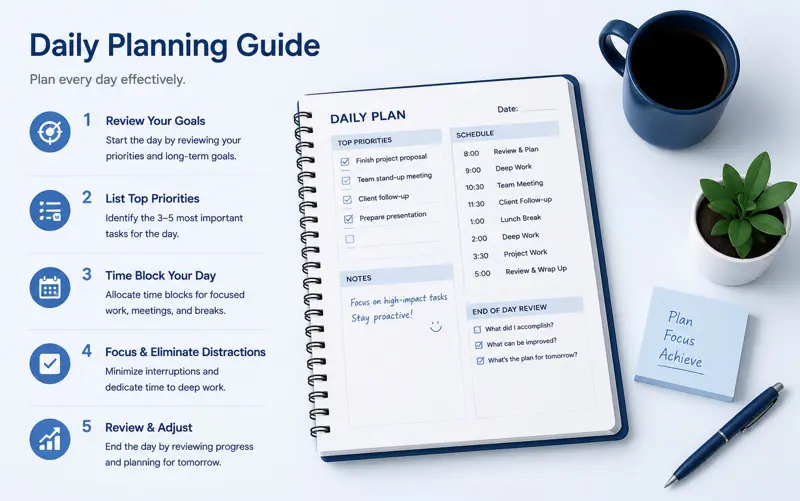
Daily Planning Guide: How to Plan Your Workday for Maximum Productivity
Successful professionals rarely rely on memory or improvisation to manage their work. Instead, they follow a structured daily planning process that helps them prioritize important tasks, allocate time effectively, and stay focused throughout the day. Whether you manage projects, supervise employees, run a small business, or simply want to become more productive, developing a daily planning routine can significantly improve your results.
Daily planning is more than creating a simple to-do list. It involves setting priorities, scheduling work, preparing for meetings, managing interruptions, and ensuring that your time is spent on activities that contribute to your most important goals.
Without a clear daily plan, employees often spend their mornings reacting to emails, attending unnecessary meetings, or responding to urgent requests that may not actually be important. By the end of the day, essential work remains unfinished while valuable hours have been lost to distractions.
Organizations also benefit when employees consistently plan their workdays. Managers gain better visibility into workloads, deadlines become easier to manage, collaboration improves, and projects move forward more predictably. Daily planning creates structure without reducing flexibility.
Modern planning software simplifies this process by combining task management, shared calendars, project schedules, reminders, workload tracking, and team collaboration in a single workspace. Employees always know what they should be working on, while managers can monitor progress without requesting constant status updates.
In this guide, you'll learn how to build an effective daily planning routine, prioritize tasks, manage time more efficiently, avoid common productivity mistakes, and use planning tools to stay organized every day.
What Is Daily Planning?
Daily planning is the process of deciding in advance how your working day will be organized. Rather than reacting to events as they happen, you intentionally define which tasks deserve your attention, when they should be completed, and how your available time will be used.
An effective daily plan typically includes:
- High-priority tasks.
- Scheduled meetings.
- Project deadlines.
- Time blocks for focused work.
- Breaks.
- Buffer time for unexpected requests.
- A review of completed work.
Having a written plan removes uncertainty and reduces the number of decisions you need to make throughout the day. Instead of repeatedly asking yourself what to do next, you simply follow the plan you've already created.
Why Daily Planning Is Important
Many people underestimate how much time is lost each day due to poor planning. Small interruptions, forgotten tasks, duplicated work, and constant switching between activities gradually reduce productivity.
A structured daily planning routine offers several important benefits:
- Clear priorities.
- Improved focus.
- Better time management.
- Reduced stress.
- More predictable project progress.
- Fewer missed deadlines.
- Improved collaboration.
- Higher personal accountability.
Planning also makes it easier to recognize when workloads become unrealistic. Instead of accepting every new request immediately, employees can evaluate how new work affects existing commitments.
Plan Tomorrow Before Today Ends
One of the most effective productivity habits is preparing tomorrow's schedule before finishing today's work.
This simple routine takes only a few minutes but eliminates uncertainty the following morning. Instead of beginning the day by deciding what deserves attention, you can immediately start working on your highest-priority task.
A practical end-of-day planning routine includes:
- Review completed tasks.
- Carry unfinished work forward.
- Identify tomorrow's three most important priorities.
- Prepare documents needed for scheduled meetings.
- Review project deadlines.
- Check your calendar.
- Leave buffer time for urgent requests.
Employees who consistently prepare tomorrow's schedule often experience less stress because they begin each day with a clear direction.
Identify Your Most Important Tasks
Not every activity contributes equally to your goals. Some tasks directly affect customers, project milestones, or business results, while others can be completed later without significant consequences.
An effective planning routine starts by identifying the few tasks that will have the greatest impact if completed today.
Many productivity experts recommend limiting daily priorities to three major tasks. This keeps the workload realistic while ensuring meaningful progress is made every day.
| Priority | Description |
|---|---|
| High | Critical work that directly supports goals or deadlines. |
| Medium | Important work that should be completed if time allows. |
| Low | Routine activities that can be postponed if necessary. |
Reviewing priorities each morning helps ensure that urgent requests do not crowd out strategically important work.
Use Time Blocking
One of the simplest ways to improve daily planning is by assigning specific time periods to different categories of work.
Instead of working from an endless task list, you reserve parts of your calendar for focused activities. This technique, known as time blocking, reduces multitasking and helps maintain concentration.
For example:
| Time | Activity |
|---|---|
| 08:30 – 10:00 | Project work |
| 10:00 – 10:30 | Email and messages |
| 10:30 – 12:00 | Customer meetings |
| 13:00 – 15:00 | Focused work |
| 15:00 – 16:00 | Planning and follow-up |
Although unexpected events may require adjustments, time blocking creates a useful framework that encourages disciplined use of working hours.
Keep Your Daily Plan Realistic
A common planning mistake is scheduling more work than can reasonably be completed in one day. Long task lists often create frustration because unfinished work simply carries over into the next day.
A realistic plan should balance ambitious goals with available time. It is usually better to complete five important tasks than to begin fifteen without finishing them.
Include time for:
- Meetings.
- Email.
- Unexpected interruptions.
- Administrative work.
- Breaks.
- Travel between locations if necessary.
Leaving some flexibility makes the schedule easier to follow and reduces pressure when priorities change.
Practical Example
Imagine a project manager responsible for coordinating several customer projects. Without a daily plan, the morning begins by checking emails, answering messages, and responding to new requests. By lunchtime, little progress has been made on strategic work.
After introducing a structured planning routine, the project manager begins each day by reviewing priorities, spends the first ninety minutes updating critical project plans, schedules meetings later in the morning, reserves the afternoon for customer communication, and finishes the day by preparing tomorrow's schedule.
Although the total number of working hours remains the same, significantly more important work is completed because priorities guide the day instead of interruptions.
If you want to improve task organization, continue with Task Management: The Complete Guide.
For practical advice on organizing an employee's schedule, read How to Organize an Employee's Workday.
You may also find Time Management: The Complete Guide helpful for developing long-term productivity habits that complement effective daily planning.
Managing Meetings Without Losing Your Day
Meetings are an essential part of business, but they can easily consume most of the working day if they are not planned carefully. One of the goals of daily planning is ensuring that meetings support productive work rather than replace it.
Before accepting a meeting invitation, ask yourself whether your participation is necessary and whether the meeting has a clear objective. If a short email or message can solve the issue, a meeting may not be required.
When meetings are necessary, schedule them in dedicated blocks whenever possible. Grouping meetings together leaves longer uninterrupted periods for focused work.
A well-planned day often reserves the morning for high-priority tasks and moves meetings to later in the day, when concentration naturally begins to decline.
Control Email Instead of Letting Email Control You
Email is one of the biggest sources of workplace interruptions. Many employees check their inbox every few minutes, breaking concentration and making it difficult to complete meaningful work.
Daily planning should include specific times for reviewing emails rather than checking them continuously throughout the day.
For example:
- Review email at the beginning of the morning.
- Check again before lunch.
- Review messages late in the afternoon.
Outside those periods, focus on planned work unless an urgent situation requires immediate attention.
This simple habit can dramatically reduce distractions while improving productivity.
Prepare for Unexpected Work
No workday unfolds exactly as planned. Customers call unexpectedly, urgent issues arise, projects change direction, and colleagues need assistance.
Rather than trying to eliminate interruptions completely, effective planners expect them.
Reserve part of each day as buffer time for unexpected requests. If no urgent work appears, this time can be used to complete additional planned tasks.
Employees who schedule every minute of the day often become frustrated because even minor interruptions force them behind schedule.
Reduce Context Switching
Frequently jumping between unrelated tasks reduces concentration and increases the time required to complete each activity.
Daily planning helps minimize context switching by grouping similar work together.
Examples include:
- Answer customer emails together.
- Schedule meetings in one block.
- Review reports during one session.
- Complete administrative work at a fixed time.
- Reserve uninterrupted blocks for project work.
Remaining focused on one type of work for longer periods generally improves both speed and quality.
Daily Planning for Managers
Managers face additional planning challenges because they balance their own work with the needs of their teams.
A manager's daily plan often includes:
- Project reviews.
- Employee meetings.
- Customer communication.
- Resource planning.
- Approvals.
- Problem solving.
- Strategic planning.
Without a structured schedule, managers often spend the entire day responding to requests while strategic priorities receive little attention.
Setting aside dedicated time for planning and decision-making helps managers maintain control of both daily operations and long-term objectives.
Daily Planning for Employees
Employees benefit from daily planning just as much as managers.
A structured workday helps employees understand what is expected, complete important assignments on time, and communicate progress more effectively.
A productive daily routine often includes:
- Review today's priorities.
- Complete the most difficult task early.
- Update task status regularly.
- Record completed work.
- Communicate blockers promptly.
- Prepare tomorrow's priorities before leaving.
Following a consistent routine reduces uncertainty while improving personal accountability.
Paper Planner or Digital Planner?
Both paper planners and digital planning tools have advantages.
A paper planner is simple, requires no technology, and can be useful for personal organization. Many people enjoy physically writing down their daily tasks because it helps reinforce priorities.
Digital planners, however, provide capabilities that paper cannot offer. Tasks can be reassigned, reminders sent automatically, calendars synchronized, and project progress shared instantly with colleagues.
| Feature | Paper Planner | Digital Planner |
|---|---|---|
| Easy to edit | Limited | Yes |
| Team collaboration | No | Yes |
| Automatic reminders | No | Yes |
| Shared calendars | No | Yes |
| Task history | Limited | Yes |
| Reporting | No | Yes |
For individuals, either approach may work well. For teams and organizations, digital planning tools usually provide greater efficiency and visibility.
Using Daily Planning Together with Project Management
Daily planning should not exist independently from larger project goals. Employees need to understand how today's work contributes to weekly, monthly, and long-term objectives.
Project management software helps connect individual daily tasks with broader project schedules, milestones, and deadlines.
Instead of maintaining separate task lists, calendars, and spreadsheets, employees work from a single system where daily activities are directly linked to ongoing projects.
This approach improves alignment across teams while reducing duplicate work.
Example: Customer Support Team
A customer support department begins each morning by reviewing overnight tickets. High-priority customer issues are assigned immediately, while routine requests are scheduled throughout the day.
Each team member has dedicated time for responding to customers, updating documentation, attending team meetings, and resolving complex issues. Because everyone follows a structured daily plan, response times improve and urgent requests receive immediate attention without disrupting the entire team.
Example: Marketing Department
A marketing team starts every morning with a short planning meeting to review campaign deadlines, content production, design requests, and advertising performance.
Designers reserve uninterrupted blocks for creative work, writers schedule time for drafting articles, and marketing managers coordinate customer approvals. By planning each day carefully, the team delivers campaigns more consistently while reducing last-minute deadlines.
If you're looking for a structured way to organize daily tasks, read Task Management: The Complete Guide.
To improve team collaboration alongside daily planning, continue with Team Collaboration Guide.
You may also find How to Track Project Progress Effectively helpful for measuring whether your daily plans are producing consistent long-term results.
Best Practices for Effective Daily Planning
Developing an effective daily planning routine is not about creating the perfect schedule. Instead, it is about building consistent habits that help you stay focused, complete meaningful work, and adapt when priorities change.
The following practices are used by many highly productive professionals across different industries.
- Plan tomorrow before leaving work.
- Identify your three highest-priority tasks.
- Schedule focused work during your most productive hours.
- Group similar tasks together.
- Limit unnecessary meetings.
- Check email only at scheduled times.
- Reserve buffer time for unexpected work.
- Take regular breaks to maintain concentration.
- Review completed work at the end of the day.
- Update task priorities as circumstances change.
Small improvements performed consistently often produce greater long-term results than dramatic changes that cannot be maintained.
Common Daily Planning Mistakes
Even experienced professionals sometimes struggle with daily planning. Most problems are caused by unrealistic expectations rather than poor intentions.
Some of the most common mistakes include:
- Planning more work than can realistically be completed.
- Treating every task as equally important.
- Starting the day by checking email instead of priorities.
- Allowing interruptions to control the schedule.
- Multitasking excessively.
- Failing to review unfinished work.
- Not leaving time for unexpected requests.
- Ignoring personal energy levels throughout the day.
- Creating a plan but never updating it.
- Working without clear deadlines.
Recognizing these habits is the first step toward building a more effective planning routine.
Create a Morning Routine
The first thirty minutes of the workday often determine how productive the entire day will become.
Rather than immediately reacting to messages and notifications, begin with a structured routine that prepares you for focused work.
An effective morning routine may include:
- Review today's schedule.
- Confirm appointments and meetings.
- Check project deadlines.
- Identify the most important task.
- Prepare any documents or materials needed.
- Begin focused work before opening email whenever possible.
Starting with purposeful work instead of distractions creates momentum that often lasts throughout the day.
End Every Day with a Review
Daily planning is incomplete without reviewing what was accomplished.
Before finishing work, spend a few minutes evaluating the day.
- Which tasks were completed?
- Which tasks need to be carried forward?
- What caused delays?
- What should become tomorrow's top priorities?
- Are any deadlines approaching?
- Does anyone need an update before tomorrow?
This short review creates a smooth transition into the next working day and reduces the time spent planning each morning.
Daily Planning for Remote Teams
Remote work increases the importance of daily planning because team members no longer share the same office environment.
Without a clear plan, employees may struggle to understand priorities, coordinate with colleagues, or know when assistance is needed.
Successful remote teams often begin the day by:
- Reviewing assigned tasks.
- Updating project boards.
- Checking shared calendars.
- Confirming meeting schedules.
- Communicating potential blockers early.
Transparent planning keeps distributed teams aligned even when employees work from different locations or time zones.
Daily Planning for Hybrid Work
Hybrid workplaces combine office and remote work, making coordination even more important.
Employees should know not only what they need to accomplish but also where their colleagues will be working, when meetings are scheduled, and which tasks require in-person collaboration.
Shared calendars, task management systems, and digital planners help hybrid teams stay organized regardless of location.
How Daily Planning Supports Long-Term Goals
Daily planning should always connect with broader business objectives. Completing many small tasks is valuable only when those tasks contribute to larger projects and strategic goals.
Organizations that connect daily activities with project milestones gain better visibility into progress while helping employees understand the importance of their work.
Managers can also identify delays much earlier because incomplete daily tasks are visible before they become missed project deadlines.
Frequently Asked Questions
When should I create my daily plan?
Many professionals prepare tomorrow's schedule before finishing today's work. Others prefer reviewing priorities first thing in the morning. Both approaches can be effective as long as planning becomes a consistent habit.
How many tasks should I plan each day?
Focus on a small number of high-priority tasks rather than creating an unrealistically long to-do list. Three major priorities are often enough for a productive day.
Should I schedule every minute?
No. Leave flexibility for meetings, interruptions, and unexpected work. Overly detailed schedules often become difficult to follow.
Is a paper planner enough?
A paper planner works well for personal organization. Teams generally benefit more from digital planning tools because they support collaboration, shared calendars, reminders, and project tracking.
How does daily planning improve productivity?
Daily planning reduces decision fatigue, improves focus, helps prioritize important work, and minimizes time lost to unnecessary interruptions.
Can daily planning reduce stress?
Yes. Having a clear plan provides greater control over the workday, making it easier to manage deadlines and avoid feeling overwhelmed by competing priorities.
Related Articles
- Time Management: The Complete Guide
- Task Management: The Complete Guide
- Project Planning Step by Step
- Project Management: The Complete Guide
- Workload Management: The Complete Guide
- How to Organize an Employee's Workday
- How to Track Project Progress Effectively
- Employee Time Tracking: The Complete Guide
- Resource Management: The Complete Guide
- Team Collaboration Guide
Final Thoughts
Daily planning is one of the simplest and most effective ways to improve productivity. A structured plan helps individuals focus on meaningful work, manage priorities, and make better use of available time. For teams, consistent planning improves communication, reduces missed deadlines, and creates greater accountability.
Whether you use a paper notebook or a digital planning platform, the key is consistency. Reviewing priorities, scheduling focused work, allowing time for unexpected requests, and evaluating progress at the end of each day can transform the way work is organized.
MyPlannerDesk helps teams turn daily planning into a seamless part of project execution. Employees can organize tasks, prioritize work, manage calendars, track time, collaborate with colleagues, and monitor progress from a single platform. Managers gain real-time visibility into workloads, deadlines, and project status, making it easier to keep teams aligned and productive.
By combining effective daily planning with modern task management and project management tools, organizations can improve productivity, reduce unnecessary stress, and consistently achieve better business results.